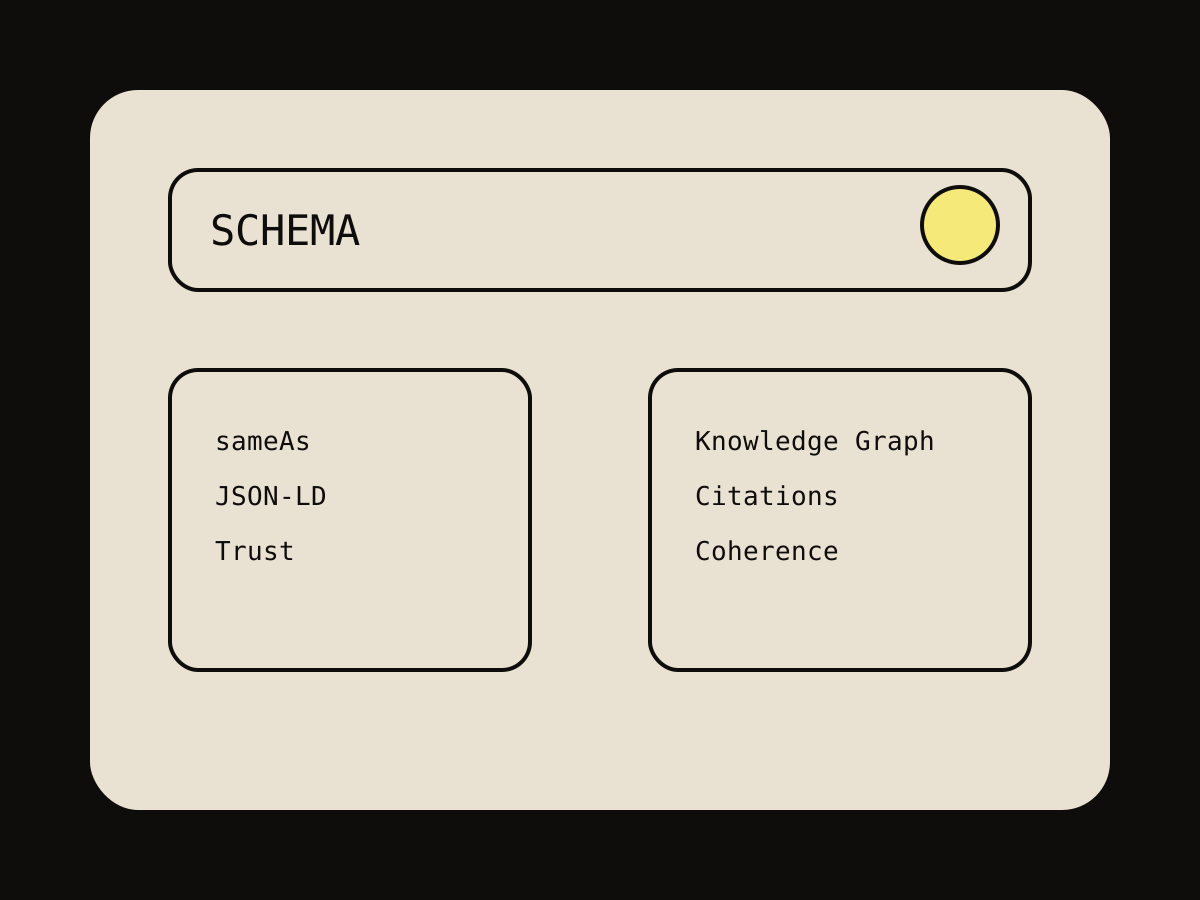
Clean schema is not page decoration. It makes an identity readable without ambiguity.
What most teams still believe
Schema.org is treated, on most sites, as a technical checkbox at the end of a project. Added to earn a star rating in search results, checked off, forgotten. That is a category error. Schema is not a display tool. It is the translation layer between what a page tells a human and what a machine can verify.
Only about 12.4% of active web domains have implemented schema.org markup to date, according to an analysis published in late 2025. In other words, the vast majority of the web speaks a language search systems and generative AIs have to guess at rather than read. This is not a technical niche. It is a market blind spot.
What Google and Microsoft have officially confirmed
Precision matters here, because the topic is saturated with vague claims. John Mueller, Google's spokesperson, confirmed in 2025 that structured data is not a direct ranking factor. That is not an opinion, it is an official statement, and it contradicts part of the marketing narrative circulating around schema. What schema does do, instead, is improve rich result display, which raises click-through rate, which then sends positive engagement signals. The effect on traditional ranking is indirect, but real.
On AI systems, the effect changes nature. Microsoft has publicly confirmed its engine uses structured markup to understand content for its generative systems. OpenAI has not made as explicit a statement, but confirmed ChatGPT uses structured data to determine which products appear in its results. And in May 2025, Google published official guidance naming JSON-LD as the preferred format for AI-optimized content, over Microdata or RDFa.
Beyond official statements, several SEO analysis firms report meaningful citation gaps between structured and unstructured content, with figures that vary by methodology. One BrightEdge study cites a 44% increase in AI citations for content with FAQPage markup. Other analyses cite multipliers near 2.5x. These figures do not always publish their full methodology. They deserve to be read as trend signals, not as strict scientific certainty.
Schema does not guarantee citation. It removes the ambiguity that prevents citation.
Proof from the field, not from theory
Here is what happens when theory stops and the source code of a real site gets opened. Mine.
A full technical audit of johnmingam.com, run in early July 2026, measured an Entity Confidence of 50 out of 100. Not a site with no ambition, a site with real foundations: a properly architected JSON-LD @graph block on the homepage, explicit entity relationships between the profile, the service offering and the Astronaut+ software, a robots.txt that explicitly welcomes AI crawlers.
But the same audit also found, in the same code:
- Structured markup present on only two of six checked pages. The other four, including the page dedicated to the method itself, are structurally invisible to a machine.
- A priceRange value literally written as "EUR EUR EUR", a string matching no valid Schema.org format.
- A sameAs field containing a Google search results URL, when sameAs is meant to point to stable entity identifiers, not a query.
- A published book whose schema states "publisher": "Self-Published", while the real publisher is different. A factual contradiction directly inside the code, the worst possible place for this kind of error.
None of these errors are visible to a human reader. The page renders normally, the design works, the text reads fine. That is exactly the problem. Schema is invisible to humans and read continuously by machines. An error that costs nothing visually can cost heavily structurally.
The mechanism, precisely
A machine deciding whether to cite an entity runs, in this order, four checks: can it identify the entity without ambiguity, can it disambiguate it from a homonym or a neighboring brand, can it connect it to its sources and creators, can it validate its existence through independent signals. Schema.org is the tool that answers the first two questions.
A malformed sameAs, a contradictory publisher, structured data missing across half a site: three different ways to fail those checks, silently, with no alert firing anywhere.
That is where Trust enters. Trust is not only about earning external mentions. Trust starts with not contradicting yourself. Broken schema is not neutral, it actively produces distrust, because a machine that detects an inconsistency between two claims about the same entity has no reason to trust a third.
The marketing edge this unlocks
Here is the question a marketing budget should ask before spending more on content: is the underlying structure capable of carrying this content all the way to a citation, or will this content pile up on a structurally shaky base? Producing more content on top of broken schema is like stacking floors on a leaning foundation. Content ROI depends directly on the quality of the structure carrying it, not the other way around.
That is a concrete budget priority shift: before the next content campaign, a structured data audit costs a few hours. A content overhaul built on a failing structure costs months, and fixes none of what makes it invisible to machines.
What this means this week
Three checks, doable in an hour, on any site, including this one.
Open the source code of every key page and verify an application/ld+json block actually exists, not just on the homepage. Validate every block found with Google's Rich Results Test, which immediately flags malformed values like a broken priceRange. Check that sameAs only contains stable entity identifiers, never a search URL or a temporary link.
These are exactly the three checks that dropped this site to 50 out of 100. They are fast to fix. They were not, as long as nobody had gone to read the code instead of the page.
What still holds true
Schema replaces neither content nor external proof. It is one of the triptych's three legs, not all three at once. Structure without Trust stays a well-organized shell. Trust without Structure stays a reputation the machine cannot find a place to hang. That is exactly why the method never measures one pillar alone.
See the full breakdown of the three pillars: SFT Method