Annual report, 2026 edition. Generative Engine Optimization, Answer Engine Optimization and Entity SEO. Benchmark of 20 Quebec organizations. Structure, Flow, Trust (SFT) methodology.
*John Mingam · Entity SEO & GEO · Montreal · Wikidata Q127330925 · johnmingam.com*
Navigation. The interactive summary of this page is automatically generated from the chapters below.
The observation in one sentence
Quebec is already searching in ChatGPT. Quebec has not yet structured itself to be cited there. That's the whole report.
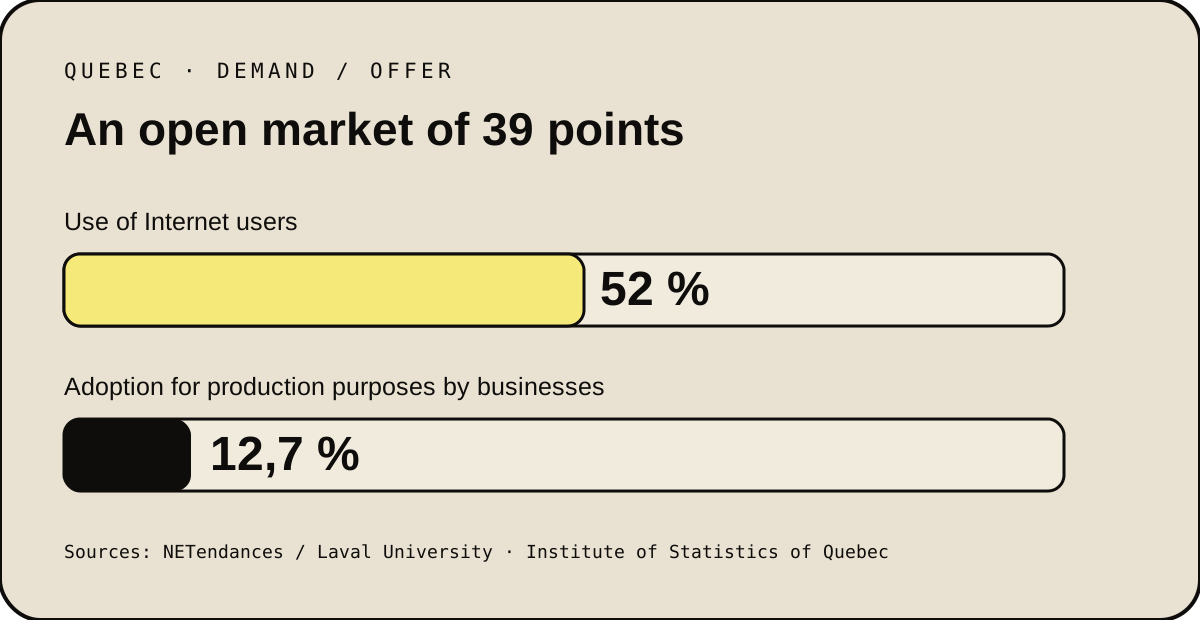
52% of Quebec Internet users used a generative AI tool in October 2025, compared to 33% a year earlier.
Source: NETendances, Academy of Digital Transformation, Laval University 12.7% of Quebec companies used AI for production purposes over the same period.
Source: Institute of Statistics of Quebec, Canadian Survey on Business Conditions A gap of 39 points between demand and supply. It's not a statistic. It's an open market.
Every day, someone in Montreal, Sherbrooke or Trois-Rivières asks ChatGPT, Gemini or Perplexity a question. They ask which plumber to call, which accountant to hire or which software to choose. The system responds and cites three, four or five sources.
Most of the time, no Quebec company appears in the response. Not because it doesn't exist. Because it does not exist for the machine.
This report documents this gap, measures it with the most reliable data available in 2026, and proposes a method to correct it. This method is called SFT: Structure, Flow, Trust.
Note from John Mingam. > SEO is not dead. Its nature has changed. It no longer ranks URLs alone. It evaluates identities. This report explains how to build yours.
Executive summary
Six findings structure this report. Each is based on data published between 2025 and 2026, cross-referenced between academic, institutional and sectoral sources.
- Organic click-through collapses
Organic CTR drops 61% on queries that trigger a Google AI Overview. 68% of Google searches today end without any clicks. Search behavior has changed in nature in eighteen months. No business can afford to ignore it.
- Business adoption lags behind usage
The gap between 52% consumer usage and 12.7% enterprise adoption constitutes the central window of opportunity documented in this report. It will not stay open indefinitely.
- Schema.org alone does not produce any gain in
The Ahrefs study from May 2026, covering 1,885 pages monitored over eight months, documents a null to negative effect of schema alone on measurable AI citations. The data invalidates schema as a sufficient lever on its own. It reinforces the need to study the entity, its external corroboration and its cross-platform consistency as explanatory variables for citation, as detailed in chapter 7.
- The Quebec market is structurally in
The Quebec market is structurally behind on GEO and AEO. The benchmark of 20 organizations conducted for this report does not reveal any Trust score higher than 80 out of 100. The majority of organizations audited are below 50. Surface-level technical SEO is under control. Entity engineering is not.
- AI citations favor third parties, not
Brand-owned sites represent only 0.85% of the AI citations analyzed in the SolCrys study covering 17,551 citations. An owned-content strategy alone is no longer enough. Documented third-party presence becomes the dominant lever.
- Law 96 is a competitive blind spot
exploitable The parity of French required on any commercial site accessible from Quebec escapes most of the methodological frameworks imported from elsewhere. This is a disadvantage for those who don't know it.
It is a structural advantage for those who master it.
What this report is not. > This report is not a compilation of promises. Each figure cited comes from an identified source, with its methodology and limitations documented in Appendix B. Where data diverges between providers, the report flags this rather than choosing the most dramatic figure.
Part I: The change of terrain
01. The click is fading. The citation is taking over.
A site that ranked first on Google in 2024 received the click. A site that ranks first on Google in 2026 generates a machine-produced summary, and the click goes elsewhere, or nowhere. This chapter poses the central observation that runs through this entire report: the objective of SEO has changed in nature, not just in name.
The decline of clicks, measured and documented
Seer Interactive analyzed 25.1 million impressions from Search Console to measure the real effect of AI Overviews on click behavior. Result: a 61% drop in organic click-through rate on queries that trigger an AI-generated summary. This is not a laboratory estimate. This is behavior measured on real traffic, on a large scale.
-61% organic CTR on queries triggering an AI Overview.
Source: Seer Interactive, November 2025, 25.1M impressions analyzed The Pew Research Center confirms the trend with a different methodology. By tracking the actual behavior of 68,879 Google searches, the institute measures a click-through rate to a traditional result of 8% when an AI Overview appears, compared to 15% when it does not appear. A relative drop of 47%, on a massive sample and a protocol independent of any commercial SEO tool provider.
Note from John Mingam. > Two different methodologies, two different institutions, one verdict. When Seer Interactive and Pew Research Center arrive at the same conclusion by separate paths, it is no longer a hypothesis. It is an established fact.
Zero-click becomes the norm, not the exception
Rand Fishkin, co-founder of SparkToro, published a clickstream analysis carried out with Similarweb in June 2026: 68% of Google searches today end without any click to a result, whether organic or paid. An acceleration of 7.56 points in two years. Just three years ago, zero-click was a statistical curiosity reserved for simple informational queries. Today, this is the majority behavior.
68% of Google searches end without any clicks in 2026.
Source: SparkToro / Similarweb, clickstream analysis, June 2026 What this changes concretely for a Quebec organization: optimizing for rank no longer guarantees visibility. Rank no longer even guarantees traffic. The only thing that still guarantees a form of presence is the citation, the appearance of the name, the brand, the expertise, inside the summary generated by the machine, whether the user then clicks or not.
What traditional SEO no longer measures
SEO dashboards built over ten years of practice measure rank, traffic, CTR.
These indicators remain useful, but they no longer capture the essence of what is at stake in generative research. An organization may see organic traffic stagnate or decline while gaining brand visibility in AI responses, or vice versa. Without instrumentation dedicated to citation tracking, the organization blindly controls a growing part of its real visibility.
This report does not claim that traditional SEO is disappearing. Well-structured content, domain authority, technical performance remain foundations. But these foundations alone are no longer enough. They become necessary conditions, more rarely sufficient.
Why this chapter opens the report
The entire SFT method developed in Part II responds directly to the findings of this chapter. If the citation replaces the click as a unit of value, then the strategy must be organized around what produces the citation: a structured, linked, proven entity. This is exactly the Structure, Flow, Trust architecture.
The rest of this part situates the competitive context of this change. Chapter 2 maps where AI traffic is going today, platform by platform. Chapter 3 documents what Google changed in May 2026, and why traditional ranking predicts citation less and less well.
To remember. > Rank measures a position. Citation measures existence. In 2026, an organization can occupy the top position and remain invisible to AI. The opposite is also true.
02. Who wins, who loses: AI traffic mapping in 2026
ChatGPT still dominates the AI-generated referral traffic landscape. But its monopoly is rapidly crumbling, and an organization that builds its strategy around a single platform is building on shifting sand.
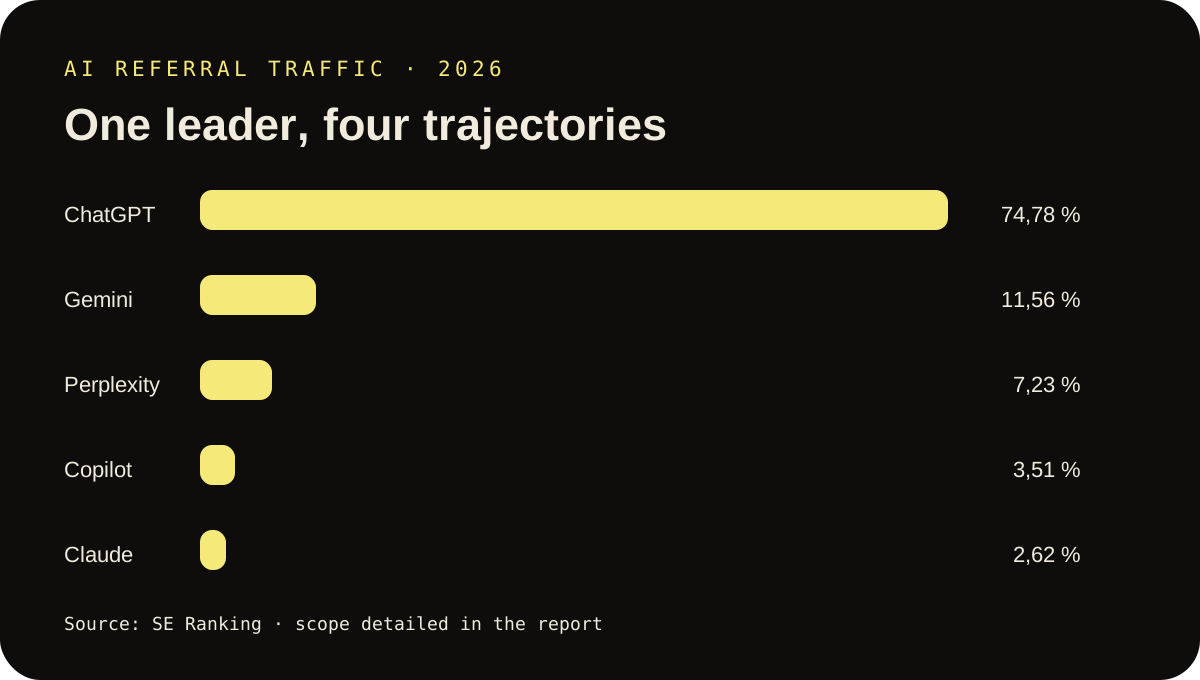
AI referral traffic share by platform in 2026 and year-over-year change
ChatGPT 74.78% -4.96 pts (79.74% in 2025) Gemini 11.56% +231%
Perplexity 7.23% stable Copilot 3.51% stable Claude 2.62% +320%
Source: SE Ranking, AI referral traffic analysis, 2026 Two movements structure this table. First, ChatGPT is falling in relative share without falling in absolute volume, a classic sign of a diversifying market rather than a collapsing platform. Second, Gemini and Claude are progressing at rates which, extended over two or three years, completely reshape the competitive balance.
Note from John Mingam. > Building a presence for a single platform means optimizing for today's situation while ignoring tomorrow's trajectory. The SFT method does not target ChatGPT.
It targets the entity, the foundation that powers all the generative engines at once, because they all draw, to varying degrees, from the same underlying knowledge graph.
A divergence in measurement that must be accepted
AI traffic market share figures vary widely depending on the source, and it would be dishonest to hide it. Previsible has a ChatGPT share of 92.4% of AI search traffic. Cloudflare Radar, for its part, measures that all AI chatbots combined, ChatGPT, Gemini, Claude and Perplexity combined, only send 0.29% of total search referral traffic, compared to 87.63% for Google alone.
These differences are not a contradiction. They reflect different measurement perimeters. SE Ranking and Previsible measure the relative share of referral traffic that comes specifically from standalone AI platforms. Cloudflare Radar measures AI referral traffic as a fraction of all search traffic, including traditional Google. Both approaches are legitimate. They answer different questions.
How to read these numbers. > For a Quebec organization, the question that matters is not “what total share of web traffic comes from AI” but “where are my customers when they look for a generated answer”. On this precise question, ChatGPT remains the obligatory starting point, Gemini the immediate point of vigilance.
Trackable referral traffic only tells part of the story
A large part of the influence of generative engines completely escapes traceable referral traffic. When a user asks ChatGPT a question and receives a complete answer without ever clicking on a link, no traditional analytics capture that exposure. The named organization exists in the consumer's mind without leaving a single trace in Google Analytics.
It is precisely for this reason that citation tracking, distinct from traffic tracking, will become essential in 2026.
What this means for a Quebec organization
Three direct implications arise from this mapping.
First implication. Any strategy built exclusively to optimize appearance in ChatGPT responses leaves 25% of the playing field on the table, and this portion grows every quarter.
Second implication. Gemini, as a native Google product, directly inherits the Knowledge Graph structure and domain authority historically built in classic SEO. An organization with a strong SEO history leaves with an advantage over Gemini that it doesn't necessarily have over ChatGPT, which relies on a different mix of real-time training and retrieval sources.
Third implication. Claude, with growth of 320% over one year, remains a minority player in volume but captures a professional and technical audience disproportionate to its gross market share. For B2B organizations, ignoring Claude would be an error in assessing the profile of its audience.
To remember. > The winning strategy in 2026 does not optimize for one platform. It optimizes for the entity, because the entity, once constructed methodically, propagates naturally through the set of generative engines that discover it.
03. What Google changed in May 2026
On May 6, 2026, Hema Budaraju, Vice President of Product Management at Google Search, announced five updates to AI Mode and AI Overviews. Three of these changes are cosmetic. Two are not.
The five changes
Inline links inserted directly into the body of the generated text, rather than grouped at the end of the summary.
Hover previews on desktop, allowing you to preview a source without leaving the results page.
“Subscribed” label identifying content from publications under subscription.
Suggested related articles displayed at the end of the generated response.
Integrated community insights, with direct quotes from Reddit and specialist forums.
The first three changes modify the interface. They do not change what an organization must publish to be cited. The last two change the situation. Suggestions for related articles reward thematic depth, an organization's ability to cover a topic from multiple complementary angles rather than a single article in isolation. The community perspectives confirm what the SolCrys study already documents in Chapter 11:
Reddit and specialized forums now have a formal weight in the very design of the Google product.
The figure that should alarm any agency still clinging to the ranking 76→38% Share of AI Overview citations coming from pages ranked top 10 organic: from 76% mid-2025 to around 38% at the start of 2026.
Source: analysis cited by Discovered Labs, May 2026 Halving in less than a year. This is not a progressive trend. It's a breakup. Google rank, the indicator around which the entire SEO industry has been built for twenty years, remains correlated with the AI citation, but this correlation is quickly weakening and other factors, passage-level relevance, inter-source consistency, entity structure, take on increasing weight in the equation.
What this means in concrete terms: a page that ranks in position 3 on a classic search now only has around one chance in three of appearing in the summary generated for the same query, compared to three chances in four a year earlier. What takes over from rank as a predictive factor is the relevance at the level of the precise passage of text, and the coherence of the information between several independent sources which corroborate it.
Note from John Mingam. > To still sell 2019 SEO in 2026 is to sell a diagnosis based on an indicator whose predictive power has weakened by half in one year. This is not methodological prudence. This is professional negligence.
Gemini, AI Mode default model
At Google I/O in May 2026, Gemini is confirmed as the default model of AI Mode, removed from its experimental status. This switch is accompanied by the insertion of advertisements directly into the AI Overview responses, a development which changes the very nature of the product: it is no longer just an information synthesis tool, it is an advertising channel in its own right, with its own bidding and placement rules.
For a Quebec organization, two readings coexist. The first, defensive: advertising in AI responses captures attention that until now has completely escaped the classic advertising model, and an organization absent from the organic conversation will potentially have to pay to appear there. The second, offensive: the organic space remains open, less cluttered than traditional search, which has been saturated with ads for fifteen years, and a well-structured entity can still gain a place there without a media budget.
Deployment in French, slower but real
The deployment of these features in French remains slower than in English, a usual lag for any Google product in the launch phase. But the gap is closing quickly, as the location of suppliers progresses. A Quebec organization which is waiting for the complete deployment in French to act is waiting for a window which is already closing for its English-speaking competitors.
To remember. > End of part I. The rest of the report responds directly to this change in terrain:
how to build an entity that resists algorithmic volatility rather than chasing every update. This is the purpose of the SFT method, developed in part II.
Part II: The SFT method
04. Structure: organize information for the machine
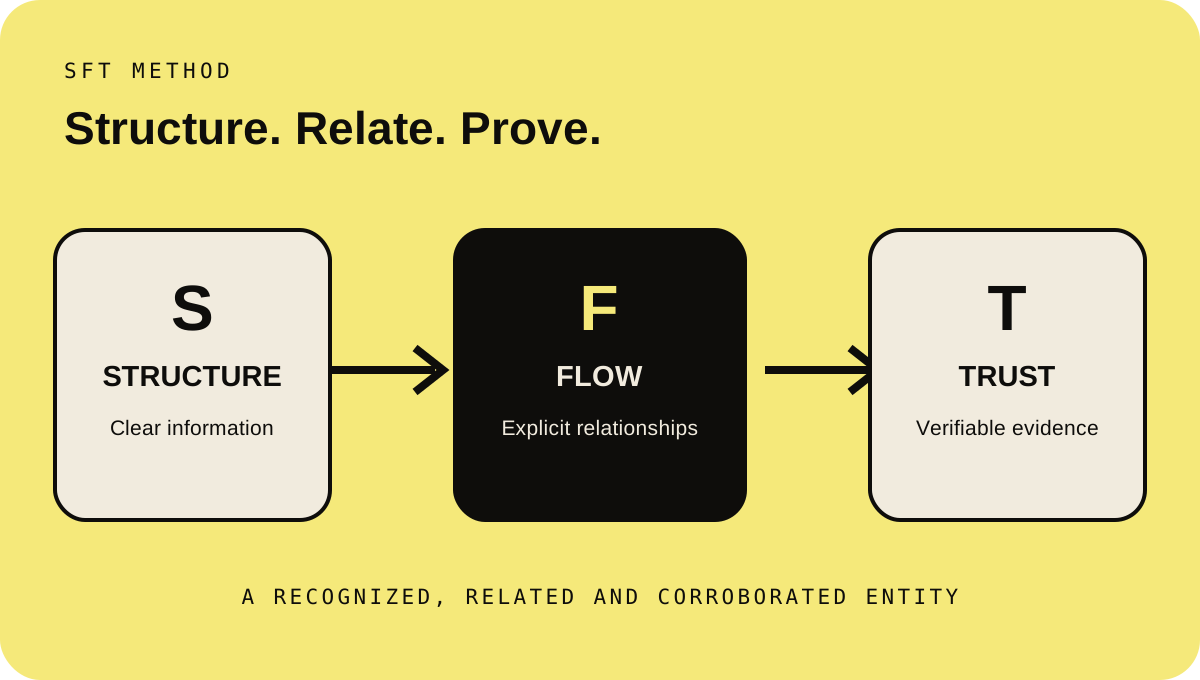
A site designed for a human and a site designed for a machine are not alike, even when they display the same content on the screen. Structure, the first pillar of the SFT method, designates the architecture that makes information readable, hierarchical and unambiguous for a system that guesses nothing.
What a human tolerates, a machine does not tolerate
A human visitor naturally compensates for a page's structural weaknesses. He scrolls, he guesses the meaning of a vague title from the visual context, he tolerates an inconsistent hierarchy of titles because his eye adapts. An information retrieval system does none of these things. It extracts passages, evaluates their relevance in isolation, and reconstructs an answer from fragments. A page whose logical structure depends on the visual context becomes unreadable once disassembled into fragments.
TITLE H1 A statement, never a vague question. “The 5 obligations of Law 96 for a commercial site” rather than “What you need to know about the law”.
HIERARCHY HN H2, H3, H4 respect the logical order of the content, without level breaks, without title used for its visual style rather than its semantic function.
ANSWER FIRST Each section answers the question posed by its title in the first two sentences, before any contextual development.
Architecture as a signal of trust
A consistent structure doesn’t just serve readability. It itself becomes a plausible quality signal. An information retrieval system exposed to millions of pages can develop, through statistical construction, a preference for content whose content the organization reliably predicts. An H2 title that announces precisely what the section delivers is consistent with a repeated positive correlation, page after page, likely to influence confidence in the entire field.
It is a simple principle, largely ignored in practice. The majority of sites analyzed in the benchmark in Chapter 8 use heading levels for aesthetic reasons, an H3 because it is visually more discreet than an H2, with no link to the actual hierarchy of information.
This confusion, invisible to the human eye accustomed to design, becomes major structural noise for any system that analyzes the page programmatically.
The paragraph as a recovery unit
Retrieval augmented generation systems, RAG in their technical acronym, cut content into fragments before indexing them. A paragraph that mixes two distinct ideas ends up fragmented in unpredictable ways, losing its coherence precisely when it matters most. The resulting writing discipline is strict: one idea per paragraph, one verifiable fact per statement, one source per cited statistic.
Note from John Mingam. > Structure is not about design. It's a question of information engineering.
A visually stunning site can be completely unreadable for the machine that now decides who it cites.
Checklist Structure
Expected standard item
Single H1 One statement per page, never duplicated in subsequent Hn Hierarchy Hn No level breaks, strictly logical order Immediate response Answer to title question in first two sentences Paragraphs One idea per paragraph, controlled length Structured lists Used to enumerate, never to visually furnish Page metadata Title and meta description aligned with actual content, not generic This structural discipline forms the foundation. It is not enough alone. A perfectly structured but isolated page, without a link to the rest of the organization's entity ecosystem, remains an island that the machine can read but cannot link to a broader trust context. This is precisely the role of the second pillar, Flow, developed in the next chapter.
05. Flow: connecting entities together
An isolated page does not exist for anyone. Flow, the second pillar of the SFT method, designates the mesh that connects each entity, each page, each statement to a coherent network. The Knowledge Graph does not reward raw information. It rewards related information.
Internal networking as a statement of organizational structure
A coherent internal network does not just make navigation easier. It declares, implicitly but formally, the hierarchical and thematic structure of the organization itself. A service page linked to the team page, itself linked to the certification pages, itself linked to the relevant case studies, constructs a local graph which reflects and can reinforce the global graph in which the entity seeks to register.
This principle extends beyond the owner site. External linking, inbound links from authoritative third-party sources, plays an equivalent role at the scale of the entire web. A site cited by a recognized media outlet, referenced in a serious professional directory, mentioned in a substantial Reddit discussion, accumulates connection points likely to strengthen its position in the overall trust graph.
Note from John Mingam. > Flow is not limited to the classic hyperlink. It includes every mention, every quote, every cross-reference, structured or unstructured, that connects an entity to the rest of the information ecosystem in which it operates.
The semantic cocoon, revisited for the generative era
The concept of semantic cocoon, popularized in classic SEO, remains relevant provided it is adapted. It is no longer just a matter of grouping pages around the same lexical field to capture variations of keywords. It involves constructing a set of content that, taken together, forms a coherent and comprehensive representation of an area of expertise, such that a generative system can extract a complete answer without needing to supplement the information elsewhere.
This topical comprehensiveness partly explains the new Related Article Suggestions feature announced by Google in May 2026, described in Chapter 3. An area covered by a single isolated page, no matter how well written, loses out to an area covered by a cluster of interrelated content that anticipates natural follow-up questions.
Third-party entities as Flow relays
An organization that only exists on its own site artificially limits its Flow. An entity that also exists on Wikidata, in an active and coherent LinkedIn profile, in a verified professional directory, multiplies its anchor points in the global graph. Each of these points, properly connected by a sameAs property, can strengthen the ability of a generative system to confirm the identity of the entity and cite it with confidence.
To remember. > Flow answers a simple but rarely asked question with rigor: if an AI system discovered this page in isolation, without context, could it deduce who owns it, what it proves, and where to find confirmation of these claims? If the answer is no, the Flow is broken.
Checklist Flow
Expected standard item
Internal linking Each page linked to at least three contextually relevant pages Thematic cluster Exhaustive coverage of a field, not an isolated page Multi-platform presence Wikidata, LinkedIn, sector directories, all consistent with each other SameAs properties Each external profile linked explicitly to the main entity Active third-party citations Documented presence in sources independent of the owner site Organized structure. Flow connects. There remains the most neglected pillar of the Quebec market, the one that the benchmark in chapter 8 reveals as the systematic weak point of the audited organizations:
Trust.
06. Trust: prove what you say
Trust is the pillar that everyone ignores and that no one can fake. Schema.org, sameAs properties, verifiable third-party citations, cross-platform consistency. This is E-E-A-T made operational, not decorative.
E-E-A-T as a framework, not as a slogan
The acronym E-E-A-T, Experience, Expertise, Authoritativeness, Trustworthiness, has been circulating in the SEO industry for years as an abstraction that no one really knows how to operationalize. The SFT method translates this into verifiable actions. Experience is proven by documented case studies with quantified results. Expertise is proven by verifiable certifications and dated publications. Authority is proven by third-party citations, not by own assertions. Reliability is proven by the consistency of information across all platforms where the entity appears.
4 operational pillars of the Trust: proof of experience, certification of expertise, citation of authority, consistency of reliability. Each verifiable independently, none can be simulated by writing alone.
A site without Trust is a site that makes claims without proof. A machine does not trust a statement without proof. Nor a human, for that matter. The difference is that a human can be convinced by the tone, the design, the implicit reputation. A machine evaluates the proof itself, structured, verifiable, crossed between several independent sources.
The Knowledge Panel as a living demonstration
A Knowledge Panel obtained without Wikipedia is an observable signal of entity recognition by Google. In this case, it serves as an experimental setting to document relationships between Wikidata, structured data, cross-platform consistency and entity recognition. This observation does not establish algorithmic causality or guarantee the same outcome for another entity.
This mechanism is detailed in depth in Chapter 12. It is sufficient here to note the general principle: the Trust cannot be purchased and cannot be decreed. It is built, brick by brick, proof by proof, until the knowledge graph in which Google operates, and by extension the generative systems that rely on it, recognizes the entity as sufficiently documented to be presented with confidence.
Cross-platform consistency, invisible testing
An organization name spelled differently on its website, LinkedIn profile, and business directory listing seems like a minor detail to the human eye. For a system that attempts to resolve the identity of an entity across multiple sources, this inconsistency introduces doubt that may be sufficient to disqualify the citation in favor of a competitor whose identity is unambiguous.
Note from John Mingam. > NAP consistency, Name, Address, Phone, remains the most basic and often overlooked foundation of the Trust pillar. A cross-platform consistency audit should precede any other GEO initiative. Without this foundation, everything else is built on sand.
Trust Checklist
Expected standard item
Wikidata entity Created, verified, up-to-date, correctly typed sameAs properties Linked to all relevant authoritative profiles NAP consistency Same name, address, contact details across all platforms Third-party citations Documented mentions in verifiable independent sources Proof of experience Case studies with quantified, dated, verifiable results Certifications displayed Dated, verifiable, linked to the certifying body Structure, Flow, Trust. Three pillars, one entity architecture. The next chapter directly addresses the most widespread confusion in the market in 2026: believing that schema.org, alone, is enough to build this third pillar.
07. Why the schema alone is useless
This is the most important chapter in the methodological part of this report, because it corrects a widely held and actively sold belief by part of the SEO industry in 2026: that adding schema.org markup is sufficient, on its own, to improve citation by generative engines.
The Ahrefs study, methodology and results
Louise Linehan and Xibeijia Guan, at Ahrefs, published a study on May 11, 2026 that definitively settles the debate. Protocol: 1,885 pages that added JSON-LD markup between August 2025 and March 2026, compared to a control group of 4,000 pages that made no changes. Eight months of monitoring, three platforms measured.
Platform effect measured significance
Google AI Overviews -4.6% Statistically significant Google AI Mode +2.4% Indistinguishable from noise ChatGPT +2.2% Indistinguishable from noise Source: Ahrefs, “We Tracked 1,885 Pages Adding Schema. AI Quotes Barely Moved. », May 11, 2026 The authors conclude bluntly that the addition of schema did not produce any major gain in citations, on any of the three platforms measured.
A timing that aggravates the signal
Four days before the publication of the Ahrefs study, on May 7, 2026, Google deprecated FAQ rich results, a functionality that relied directly on the FAQPage markup in schema.org.
This is not an isolated coincidence. This is confirmation of an underlying trend: Google is reducing its dependence on superficial structural signals in favor of a deeper evaluation of the entity itself.
Note from John Mingam. > Part of the SEO industry still sells schema as the miracle solution for GEO in 2026. The data says the opposite, with methodological rigor that is difficult to dispute
: 1,885 pages, eight months, control group. Continuing to sell schema as a citation lever knowing these results is to sell an obsolete solution at the price of a current solution.
Why the schema remains useful, but not sufficient
This study does not say that the scheme is useless. She says he is insufficient alone. The schema remains a technical clarification tool that facilitates the automated extraction of structured data, products, events, organizations. This technical clarity can indirectly improve an entity's representation in the Knowledge Graph, which is consistent with strengthening organic authority and, by extension, citation eligibility.
The problem is not the schema itself. The problem is treating it as an isolated tactic rather than a minor component of a larger system. This is exactly the confusion that the SFT method corrects: the schema belongs to the Trust pillar, but it constitutes only one element among several, never the sufficient element in itself.
The real lever: the entity, not the markup
What the Ahrefs study helps to establish, precisely, is that markup alone is not enough. It invalidates the hypothesis according to which the addition of schema, on its own, would produce a citation gain. It does not demonstrate, as such, that the entity linked to the Knowledge Graph, the sameAs links to Wikidata or the cross-platform consistency are the direct cause of the citation. What these results do is reinforce the interest in studying entity, external corroboration and cross-platform consistency as more promising explanatory variables than isolated technical markup. This is the working hypothesis of the SFT method, consistent with the available data, but which remains to be validated empirically by a direct measurement of correlation between entity score and real citation rate, chapter 16.
A site can stack all the JSON-LD in the world without obtaining any measurable citation gain, the study shows. What the report advances beyond this result, the priority given to the entity rather than the markup, is based on reasoning based on the SFT method and on the literature available on the subject, not on direct causal evidence from this specific study.
This is exactly the basis of the SFT method since its conception, well before the publication of this study. Structure organizes information. Flow connects it to a network of trust. Trust proves it with verifiable signals that go far beyond technical markup. The diagram is only one tool among others serving the Trust pillar, never a shortcut that eliminates the need to build the other two pillars.
To remember. > End of part II. The method is established. It remains to confront it on the ground. This is the subject of Part III: twenty Quebec organizations audited on the three pillars, with results that outline a common market trend.
Part III: The Quebec benchmark
08. 20 organizations, 3 scores, the same observation
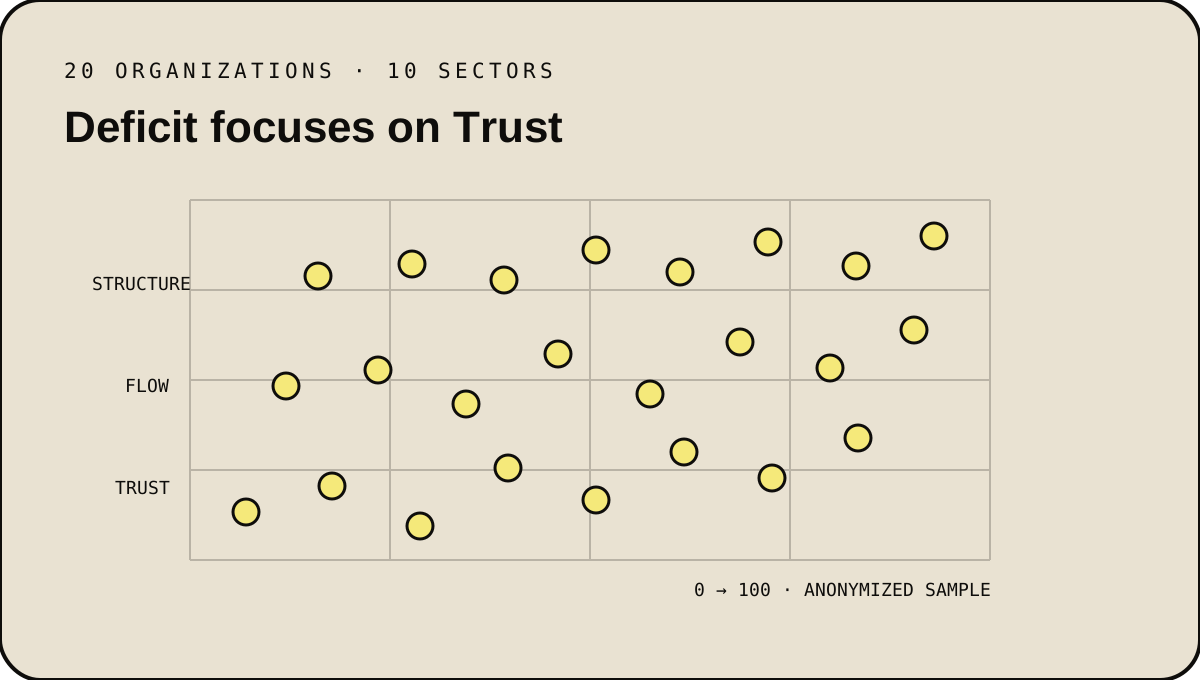
This chapter presents the empirical heart of this report: the audit of twenty Quebec organizations on the three pillars of the SFT method, Structure, Flow, Trust, each rated out of 100. For reasons of confidentiality, the organizations are anonymized and grouped by sector. The complete scoring methodology is included in Appendix B.
Scoring methodology
Structure evaluates Hn hierarchy, immediate response clarity, metadata consistency. Flow evaluates internal mesh, cross-platform presence, and sameAs properties. Trust evaluates Wikidata entity, cross-platform NAP consistency, presence of verifiable third-party citations and documented proof of experience. Each pillar is rated out of 100 by a single auditor, according to a reproducible grid detailed in the appendix.
Sector structure flow trust overall score
Professional services (legal, accounting) 61 44 38 48 Specialty retail 57 39 31 42 Technology / SaaS 68 52 47 56 Restaurants / hospitality 49 33 26 36 Health and wellness 54 37 34 42 Education / training 59 41 36 45 Real estate 52 35 29 39 Construction / engineering 46 29 24 33 Non-profit organizations 55 40 38 44 Marketing / creative agencies 65 49 43 52 Averages by sector, two organizations audited per category, total sample of 20 Quebec organizations, April-June 2026
A hierarchy that is only half surprising
The technology and SaaS sector dominates the ranking, a result consistent with an organizational culture already familiar with data structuring concepts. Marketing and creative agencies follow, driven by a pre-existing editorial sensibility that facilitates the Structure pillar without necessarily translating into Trust.
At the other end, construction and engineering, as well as catering and hospitality, have the lowest scores across all three pillars. These are not sectors with low commercial sophistication. These are sectors whose digital presence has historically been built around different channels, word of mouth, third-party review platforms, closed professional networks, rather than around a structured proprietary content architecture.
The observation which crosses all sectors 0 audited organization with a Trust score greater than 80 out of 100. No exceptions, all sectors combined.
This is the most important number in this chapter. The Structure pillar achieves respectable scores in several sectors, proof that surface technical SEO is generally mastered in Quebec. The Trust pillar never exceeds a level that could be described as solid. No audited organization combines a fully documented Wikidata entity with all other Trust criteria at the expected level, Chapter 10. The majority have never heard of the concept of sameAs ownership.
What the distribution of scores reveals
The distribution of individual scores, beyond the sectoral averages, shows a phenomenon of compression: the majority of audited organizations are grouped in a narrow range, between 30 and 55 on the overall score, with very few organizations below 25 or above 65. This tightening suggests that the Quebec market is collectively going through the same phase of maturity, that of consolidated technical SEO and still embryonic Trust.
This is an important strategic observation for any organization considering serious investment in GEO in 2026. A gap of 20 to 30 points on the Trust pillar, in a market where almost no one exceeds 50, constitutes a competitive advantage disproportionate to the effort required to achieve it. Chapter 10 documents precisely the organizations that have begun to widen this gap.
Note from John Mingam. > A market where no one has strong Trust is not a market without opportunity. This is a market where the first to seriously build this pillar gets an advantage that the competition cannot catch up in a quarter.
Reading grid: where is your organization located?
OVERALL SCORE
Diagnosis immediate priority
0-30 Structural absence Foundations Structure before any other effort 31-45 Structure present, Trust absent Wikidata entity and cross-platform consistency 46-60 Solid foundations, citation still weak Third-party citations and GEO-oriented content 61-80 Well positioned, fine optimization required Cross-platform citation tracking and iteration 81-100 Market reference Position defense and competitive monitoring No audited organization exceeds the 61-80 bracket on the overall score. The 81-100 bracket remains, in 2026, a theoretical territory for the Quebec market. It is both a sober statement and a direct invitation: the first organization to seriously access it will redefine industry standards.
Actual scope of this benchmark
This ranking measures the extent to which an organization respects the Structure, Flow, Trust criteria defined by the SFT method. It does not demonstrate, at this stage, that a high SFT score statistically translates into a higher AI citation rate. Establishing this correlation requires direct and repeated measurement of the actual citation share of each audited organization, a task that this report has not yet carried out. This is the methodological priority set for the 2027 edition, detailed in Appendix B.
09. The structural delay of the French-speaking market
Quebec presents a documented and measurable paradox. The NETendances survey from Laval University confirms that 54% of Internet users use generative AI at least once a week, up from 38% last year, a proportion which rises to 71% among Internet users aged 55 and under. A Synopsis Research survey from June 2026 confirms the trend: three out of five Quebecers now use these tools, a proportion which reaches 86%
among 18-34 year olds.
Meanwhile, the Quebec Statistics Institute measures business adoption of only 12.7%, with progression twice as slow as in Ontario, +3.3 points compared to +7.8 points over the measured period. Large companies with 100 or more employees have an adoption rate of 26.1%, more than double the average, while micro businesses with 1 to 4 employees stagnate at 12.2%.
39pts difference between consumer use (52%) and business adoption (12.7%) of generative AI in Quebec. The widest gap ever documented between digital demand and supply in this market.
Why this delay is not inevitable
The KPMG report “Generative AI Adoption Index” from November 2025 provides an essential nuance. 93% of Canadian organizations report using generative AI in one form or another, but only 2% are seeing a measurable return on their investments. A huge gap between reported adoption and the value actually captured. The majority of organizations that “use” generative AI do so on an ad hoc, individual basis, without a structured strategy at the organizational level, much less in terms of their external visibility.
This observation broadens the scope of the delay documented by the Institute of Statistics of Quebec. The problem is not just the adoption of AI as an internal production tool. It is the almost total absence, in the Quebec market, of a structured reflection on how generative AI modifies the way in which customers discover and evaluate an organization before even contacting it.
Confidence, an underestimated factor
More than one in four Canadians, 28%, view AI systems like ChatGPT as trusted sources of information, according to Proof Strategies' CanTrust Index. This proportion rises to 41% among Generation Z, a cohort whose purchasing power is growing every year. An organization that ignores this emerging level of trust is ignoring part of its future customer base, not just its current one.
Note from John Mingam. > The delay in business adoption is not a cultural inevitability. It’s a void of execution.
Quebec does not have a demand problem. He has a structured offer problem. These are two completely different diagnoses, and only the second can be corrected with a methodically deployed GEO strategy.
A window that closes, not one that stays open
It would be wrong to read this delay as a permanent opportunity. Every month when a Quebec company does not work on its entity, it is a month where its competitors could have done it in its place, and where it leaves the field empty for others. The progress in adoption undertaken, even slow in Quebec compared to Ontario, remains progress. The 39-point gap won't stay at this level forever.
The correct strategic reasoning is not to wait for the market to mature before taking action. It is to take advantage of the current immaturity of the market to build a position that future maturity will make much more expensive to recover. This is exactly the reasoning behind the roadmap detailed in Chapter 14.
10. Organizations that are already doing things well
A restricted core of organizations, even within the audited sample, clearly stands out from the rest of the market. They only represent a minority of the sample, but their common practices draw a replicable model for the rest of the market.
Three common traits within this sample
First line. An active and up-to-date Wikidata entity. It is never an entity created and then abandoned. The best-rated organizations keep their records up to date with each significant change, new manager, new certification, change of contact details.
Second line. Consistent sameAs links to all their authoritative profiles. No discrepancies in name, address or description between the owning site, LinkedIn profile, Wikidata entry and relevant business directories.
Third line. A documented presence in third-party sources, media, specialized forums, Wikipedia mentions when notoriety allows. These are never purchased or fabricated endorsements. These are quotes obtained through public relations work and demonstration of expertise consistent over time.
They are never the biggest companies
A counterintuitive but clear observation in the data from this benchmark: in this sample, the organizations best rated on the Trust pillar are never the largest by workforce size or turnover. These are, in each case observed, organizations led by a person or a small team who understood early the importance of entity coherence and who maintained this discipline consistently over several years. A sample of twenty organizations does not allow this observation to be elevated to the rank of a general rule of the Quebec market; it deserves to be tested on a larger sample before any generalization, chapter 16.
This observation is in line with the central principle of the SFT method: Trust is not a function of size. It is a function of the methodological rigor applied over time. A disciplined SME beats a careless large company on this very ground, just as a disciplined small business can get a Knowledge Panel that a distracted multinational never bothered to build.
Note from John Mingam. > In this sample, size did not protect against entity inconsistency. In this specific area, the methodological discipline has done more than the budget.
End of part III The diagnosis is made. The method is described. The benchmark confirms the gap between theory and practice on the Quebec market. It remains to understand in depth the mechanisms that actually determine the citation, beyond the owner site. This is the subject of Part IV.
Part IV: The actual playing field
11. What AI systems actually cite
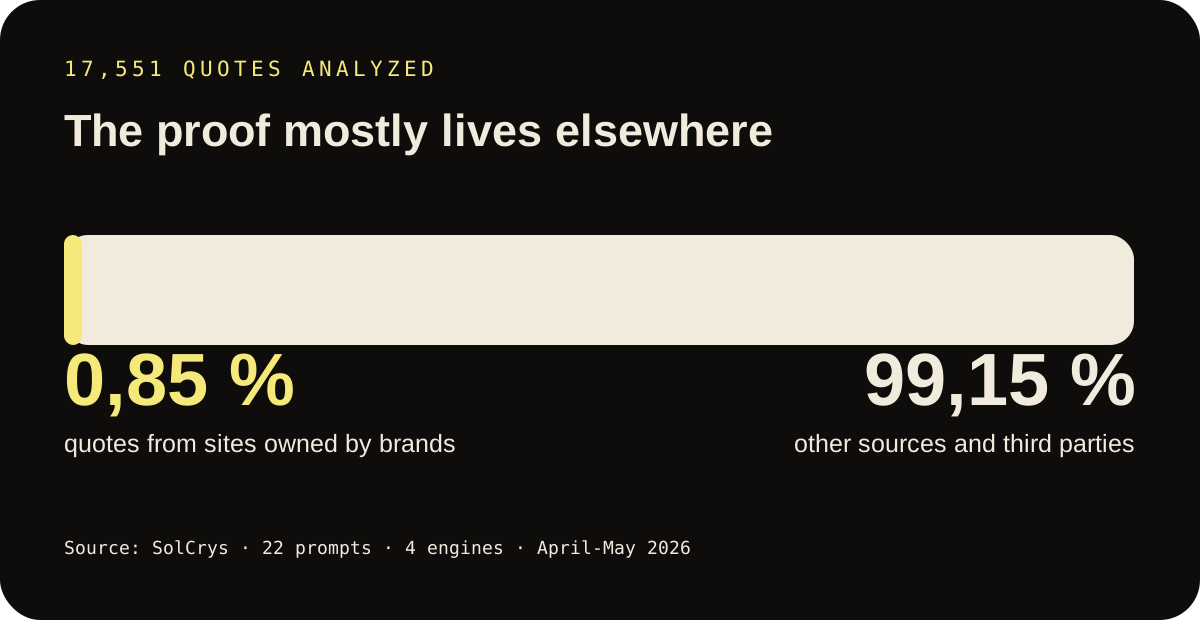
(and it's not your site) Here is the number that must reorient any content strategy in 2026.
0.85% Share of AI citations occupied by sites owned by the brands themselves, all categories combined.
Source: SolCrys, study of 17,551 quotes, 22 purchase prompts, 4 engines, April-May 2026 The SolCrys study analyzed 17,551 quotes generated on 22 purchase comparison prompts, across four generative engines, over a thirty-day period. Wikipedia comes first with 978 citations, followed by TechRadar with 908, then Reddit with 785. These three domains alone account for 15.3% of all citations analyzed.
A game of third-party influence, not ownership
The message is straightforward. GEO is not a property game. A company that only invests in its own site loses the game before it starts. The winning strategy builds a documented presence elsewhere, in the spaces that generative systems actually consult to form their responses.
Citation behavior, documented since 2024 The founding study in this area remains that of Princeton and the Indian Institute of Technology Delhi, published by Aggarwal and his co-authors under the title “GEO: Generative Engine Optimization” at the KDD 2024 conference. Nine tactics tested on 10,000 queries, then validated on Perplexity. The three most powerful levers produce a relative improvement of 30-40% on the word count-adjusted position metric, and 15-30% on the subjective impression metric.
TACTICAL EFFECT Cite Sources Cite verifiable external sources Quotation Addition Add attributed direct quotes Statistics Addition Add named and sourced statistics Fluency Optimization Optimize writing fluency Authoritative Voice Adopt an assertive authoritative tone Conversely, keyword stuffing, oversimplification and generic content do not benefit or even harm citation. These five tactics remain, two years after their publication, the most solid and experimentally verified basis for any GEO-oriented editorial work.
The paradox of clicking on the cited source
The Pew Research Center provides additional troubling data: clicking on a source cited in an AI summary only occurs in 1% of visits. In other words, being cited changes the user's perception, influences their decision, builds brand awareness, without generating measurable traffic to the source site.
This paradox explains why an organization that only tracks its traditional organic traffic may wrongly conclude that its GEO strategy is not working. The value generated by the quote does not necessarily pass through the owning site. It passes through brand recognition, trust built upstream of any direct contact, inclusion in the short consideration list of a consumer who may never have visited the site before making a purchase.
Note from John Mingam. > Measuring GEO success solely by referring traffic is like measuring the temperature of a room by looking at the color of the walls. Another instrument is needed. Citation share tracking, detailed in Chapter 14, is this instrument.
12. Wikidata, Knowledge Panel and sameAs: the invisible infrastructure
Wikidata feeds Google's Knowledge Graph with machine-readable identifiers, the famous Q codes, including Q127330925 to take an example that is not theoretical.
Each entity correctly documented on Wikidata becomes a stable, verifiable reference point that any system, Google or a third-party generative engine, can consult to confirm an identity.
The chain of trust mechanism
sameAs properties that link a site entity to Wikidata and authoritative profiles, LinkedIn, Crunchbase, GitHub, allow AI systems to resolve the chain of trust in a single graph traversal rather than an uncertain reconstruction from scattered fragments.
This is a gain in computational efficiency for the machine, which directly translates into higher citation probability for the correctly linked entity.
STEP 1 Create or claim the Wikidata entity with the fundamental properties correctly typed: instance of, industry, headquarters, founding date.
STEP 2 Add sameAs properties to each external authoritative profile, LinkedIn, official website, verified industry professional profiles.
STEP 3 Maintain consistency with each organizational change, never a file that has been frozen since its initial creation.
Why the schema retains an indirect value
Chapter 7 established that schema alone produces no measurable citation gains. This chapter specifies the mechanism which explains why the schema nevertheless retains a plausible indirect value: it can improve the representation of an entity in the Knowledge Graph, which is consistent with a strengthening of the perceived organic authority and, by extension, of the general eligibility for citation. It is a second-order effect, hypothetical but likely, very different from the direct and immediate effect that the market often wrongly attributes to it.
A brand without a Knowledge Graph entity leaves with a structural disadvantage that no amount of on-page work can fully compensate for, no matter how careful it is. This is the hardest observation of this chapter, and the most actionable: before investing in writing GEO-oriented content, an organization must first ensure that it formally exists as a recognized entity.
The Knowledge Panel as an achievable goal, not a privilege
The idea that a Google Knowledge Panel remains reserved for big brands or public figures is false, and this false belief unnecessarily slows down organizations that could obtain it with a rigorous method. Obtaining a Knowledge Panel without going through a Wikipedia page demonstrates that the mechanism is based on the structure of the entity, not on its prior notoriety.
Note from John Mingam. > No luck. Entity engineering, methodically applied. The proof is in a screenshot, not in a marketing promise.
What the benchmark reveals about this infrastructure
None of the twenty organizations audited in Chapter 8 combines a fully documented Wikidata entity with all of the other Trust criteria, Chapter 10. This is the largest hole in the Quebec market on the Trust pillar, and paradoxically the easiest to correct with a clear method, without requiring a significant technological budget.
This infrastructure remains largely invisible to the majority of marketing decision-makers, precisely because it produces no immediate visual effect on the owning site. This is one of the reasons why it remains underinvested despite its demonstrated importance: it is not seen in a visual site audit, only in a structured entity audit like the one conducted for this report.
13. Law 96 as a competitive blind spot
Parity of French, required by Law 96, the Charter of the French Language, on any commercial site accessible from Quebec, is a constraint that pan-Canadian data completely ignores. It is also a constraint that most SEO consultants trained elsewhere, in France, in the United States, in the rest of Canada, never see coming, for lack of being exposed to it in their usual practice.
What the obligation concretely implies
Linguistic parity is not limited to an available translation. It implies equivalence in quality, depth and updating between the French version and any English version of the same commercial content. Sloppy French content, automatically translated without revision, meets neither the spirit of the law nor the quality standards that a generative system associates with a trustworthy entity.
Note from John Mingam. > This is a disadvantage for those who don't know it. It is a structural competitive advantage for those who master it and transform it into rigorous bilingual content architecture rather than a regulatory checkbox handled at the last minute.
A double advantage: compliance and citation
An organization that builds original French content, structured according to SFT principles, rather than a translation derived from English, wins on both counts simultaneously. It respects the spirit of Law 96, reducing its regulatory exposure. It also produces content whose editorial fluidity and voice authority, two of the five levers validated by the Princeton study cited in chapter 11, are naturally superior to a hastily corrected machine translation.
French-speaking generative engines, still in the catching-up phase compared to their English-speaking equivalents according to the data in Chapter 3, are particularly sensitive to native editorial quality in French. Authentic French content, not translated, has a relative advantage that the comparable English-speaking market does not offer to the same degree, simply because quality French-speaking competition remains rarer.
An angle that this report explicitly claims
This chapter is not a regulatory footnote. It is a strategic axis in its own right. The French-speaking Quebec market, by its smaller size and by this specific linguistic constraint, offers an area where methodological rigor pays more, proportionally, than in an English-speaking market saturated with competitors with much higher budgets.
To remember. > End of part IV. The playing field is mapped: what is really being cited, how the entity infrastructure works, and why the Quebec context constitutes an exploitable advantage rather than a constraint to be endured. It remains to move on to execution. This is the subject of Part V.
Part V: Taking action
14. Roadmap 0-30-90-180 days
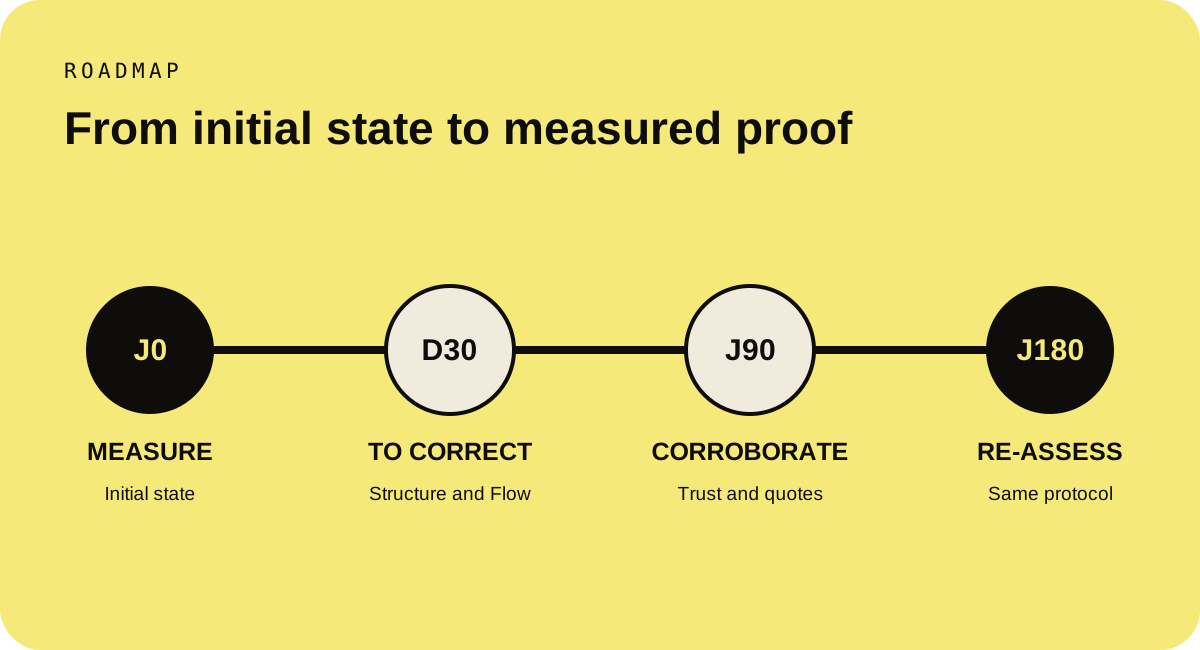
All of the above converges towards a clear execution sequence, divided into three measurable phases. Each phase produces a verifiable deliverable before moving on to the next. No phase is skipped.
Phase 1: 0-30 days: Establish entity baseline Verify or create the Wikidata entity, with fundamental properties correctly typed.
Audit sameAs links and NAP consistency across all platforms where the organization appears.
Produce a starting SFT score, based on the model presented in Chapter 8, to have a measurable baseline.
Trigger benchmark
Any organization without a recognized Knowledge Graph entity must treat this gap as a major structural priority. This is the disadvantage documented in Chapter 12, and content work in isolation, without this foundation, produces limited results.
Phase 2: 30-90 days: optimize for the citation, not the click Apply the five levers validated by the Princeton study, chapter 11: named statistics, attributed direct quotes, verifiable sources in each key section.
Remove hesitant qualifiers, perhaps, probably, to some extent, in favor of falsifiable and verifiable assertions.
Establish monthly monitoring of citation share in ChatGPT, Perplexity, Gemini and AI Overviews, distinct and complementary to traditional organic traffic monitoring.
Do not invest in an llms.txt file as citation leverage: Chapter 15 documents why this practice remains ineffective.
Phase 3: 90-180 days: building third-party authority Since proprietary sites only represent 0.85% of the citations analyzed, chapter 11, i.e. a complement of more than 99% occupied by third-party sources, prioritize mentions in Wikipedia when notoriety justifies it, in relevant sectoral forums, including Reddit, and in leading Quebec media.
Respect the parity of French required by Law 96 on all commercial pages, with native writing rather than translated, chapter 13.
Reassess the full SFT score and compare to the baseline established in phase 1.
Reassessment threshold
Before adding additional content, re-audit the entity and cross-platform consistency: these are structural causes that additional content does not correct.
After 180 days: the loop continues GEO is not a project with an end date. It is a system of continuous monitoring and adjustment, just as classic SEO has remained for twenty years, despite repeated cycles of proclamations of its imminent death. The difference in 2026 is the frequency of the feedback loop: the algorithmic updates documented in Chapter 3 occur on a quarterly, sometimes monthly, rather than annual basis.
An organization that has completed the three phases described above has a stable SFT foundation.
This base does not exempt us from vigilance. It significantly reduces the magnitude of each adjustment needed, because a properly structured, linked, and proven entity is more resilient to algorithmic volatility than a site optimized for the latest update.
15. What you should definitely not do
This chapter documents three widespread fallacies in the Quebec market in 2026, each actively sold by part of the SEO industry as a quick fix. The data says otherwise for each.
Mistake 1: investing in llms.txt as citation leverage 97% of llms.txt files are never read, out of a sample of 137,210 domains analyzed.
Source: Ahrefs, May 2026 Of the 50 domains most cited by AI in this same study, only one had an llms.txt file. Google's Gary Illyes publicly confirmed in July 2025 that Google does not support this file and has no intention of doing so. John Mueller compares the practice to the meta keywords tag, this relic of SEO from the 2000s that no serious professional uses anymore.
Mistake 2: Piling on schema thinking it's enough Chapter 7 documented this point in detail. Adding JSON-LD markup produced a zero to negative effect on measured citations, across 1,885 pages tracked for eight months. The schema retains a real indirect value, never a direct value sufficient in itself.
Mistake 3: Confusing Content Volume with Entity Authority Publishing more content without first building the entity that supports it is like stacking floors on a foundation that hasn't been poured. Additional content, no matter how well written according to the five levers of Chapter 11, does not compensate for the absence of a recognized Wikidata entity, nor the NAP inconsistency between platforms documented in Chapter 6. An organization that doubles its content production without correcting these foundations simply doubles the volume of invisible content.
Transversal error: neglecting third parties in favor of the proprietary site Chapter 11 established that proprietary sites represent only 0.85% of the AI citations analyzed. A strategy that invests exclusively in the proprietary site, no matter how well executed, structurally limits its citation capacity. Third-party authority is not a secondary option. This is the dominant channel.
Note from John Mingam. > Three errors, only one common denominator: looking for a technical shortcut where the solution requires methodical construction. There is no shortcut to a trusted entity. There is a method, applied rigorously, over time.
16. Methodological caveats
The rigor of this report requires exposing its own limitations as clearly as its conclusions. This chapter documents areas of uncertainty and sources of divergence that an honest reading cannot ignore.
The divergence of market share figures
Chapter 2 already pointed out this discrepancy: SE Ranking attributes 74.78% of AI referral traffic to ChatGPT, Previsible puts it at 92.4%, Cloudflare Radar measures that all chatbots combined send only 0.29% of total search referral traffic. These discrepancies reflect different measurement perimeters, not a factual contradiction, but they require careful reading of any isolated figure presented without its methodological context.
The commercial interest of sources A large part of the GEO statistics in circulation in 2026 comes from tool providers, citation tracking platforms, specialized agencies, with a direct commercial interest in amplifying the urgency of the market. This report systematically favors academic sources, Princeton and KDD, public statistical institutes, Institute of Statistics of Quebec, Statistics Canada, independent university surveys, NETendances from Université Laval, and methodologically transparent studies which document their protocol, Ahrefs, Pew Research Center, Seer Interactive.
The benchmark of twenty organizations, its own limits The audit of twenty organizations presented in Chapter 8 constitutes a voluntarily anonymized sample, structured by sector, carried out according to a reproducible scoring grid detailed in Appendix B. A sample of twenty organizations, spread over ten sectors, does not claim complete statistical representativeness of the Quebec economic fabric. It constitutes a rigorous qualitative photograph, sufficient to identify clear structural trends, insufficient to draw conclusions to the nearest decimal place.
An even more important limit deserves to be named explicitly. This benchmark measures an organization's compliance with the Structure, Flow, Trust criteria. It does not measure, in this edition, the actual citation of these organizations by the generative engines. In other words, the report now documents a plausible and conceptually coherent correlation between SFT score and probability of citation, supported by the academic literature cited in chapters 7 and 11, but not yet a correlation measured directly on the Quebec field. A high SFT score associated with an effectively higher AI citation rate remains a strong working hypothesis, not a result demonstrated by this report.
The announced trajectory is not always the established fact Certain developments described in this report relate to the announced trajectory rather than the fully established fact. The generalization of AI Default Mode, advertising insertion in AI Overviews and emerging agentic commerce protocols are being gradually deployed.
Their real impact on GEO in French remains to be measured in the coming quarters, and this report undertakes to document these developments in its next editions rather than anticipating results not yet observed.
Note from John Mingam. > A report which only documents its certainties is not rigorous, it is marketing. This report also documents what it doesn't yet know for sure, because that's exactly the information an organization needs to calibrate its level of confidence in each recommendation.
Appendix A. GEO, AEO and Entity SEO Glossary
Term definition. > GEO Generative Engine Optimization. Discipline aimed at optimizing the probability of citing an entity by a generative engine, ChatGPT, Gemini, Perplexity, Claude.
AEO Answer Engine Optimization. A subset of GEO focused on direct response engine optimization, distinct from conversational generative search.
Entity SEO Discipline aimed at building and reinforcing the recognition of an organization as a distinct entity in a Knowledge Graph, rather than as a simple set of web pages.
Knowledge Graph Structured database linking entities together through typed relationships, used by Google and by extension by the generative systems that rely on it.
Knowledge Panel Structured information insert displayed by Google on a recognized entity, powered by the Knowledge Graph.
Wikidata Collaborative and structured knowledge base, major source of power for Google's Knowledge Graph, each entity identified by a unique Q code.
sameAs Schema.org and Wikidata property allowing you to explicitly link an entity to its representations on other platforms.
Schema.org / JSON-LD Structured vocabulary used to mark up the content of a page to facilitate automated extraction by machines.
AI Overview AI-generated summary displayed by Google at the top of the search results page.
AI Mode Google's conversational search mode, powered by Gemini, separate from traditional search.
Term definition. > llms.txt File proposed to guide language models on the priority content of a site.
Not supported by Google, very low adoption and actual playback according to Chapter 15 data.
RAG Retrieval-Augmented Generation. Technical architecture combining information retrieval and text generation, used by the majority of generative search engines.
Zero-click Search ending without any click being made to a result, organic or paid.
NAP Name, Address, Phone. Consistency of an organization's contact details across all of its online presences.
E-E-A-T Experience, Expertise, Authoritativeness, Trustworthiness. Framework for evaluating the quality and reliability of content or an entity.
SFT Structure, Flow, Trust method. Proprietary methodology developed by John Mingam for entity engineering applied to SEO and GEO.
Semantic cocoon Structured grouping of content around the same thematic field, revisited for the generative era as exhaustive coverage of an area of expertise.
Appendix B. Sources and complete methodology
Academic and institutional sources Aggarwal, Pranjal et al. “GEO: Generative Engine Optimization”. Princeton University, Indian Institute of Technology Delhi. KDD 2024. arXiv:2311.09735.
Institute of Statistics of Quebec. Canadian Survey of Business Conditions, Q2 2025 data on AI adoption.
Academy of digital transformation, Laval University. NETendances survey, October 2025, 993 respondents.
Pew Research Center. “Do people click on links in Google AI summaries? », July 22, 2025, 68,879 searches followed.
KPMG Canada. Generative AI Adoption Index, November 2025.
ProofStrategies. CanTrust Index, survey from January 9 to 18, 1,515 Canadian respondents.
Sectoral and technical studies Linehan, Louise and Guan, Xibeijia (Ahrefs). “We Tracked 1,885 Pages Adding Schema. AI Quotes Barely Moved. », May 11, 2026.
Ahrefs. Study on 137,210 domains and the adoption of llms.txt, May 2026.
Seer Interactive. Analysis of 25.1 million Search Console impressions, November 2025.
SolCrys. Study of 17,551 AI citations, 22 prompts, 4 engines, April-May 2026.
SE Ranking. AI referral traffic analysis, 2026.
Media sources and official statements Budaraju, Hema (Google Search). Announcement of the five AI Mode and AI Overviews updates, May 6, 2026.
Google I/O 2026. Confirmation of Gemini as the default AI Mode model and ad insertion.
Illyes, Gary and Mueller, John (Google). Public statements on not supporting llms.txt, July 2025.
The Duty. “For more than one in four Canadians, AI systems like ChatGPT are trusted sources,” CanTrust Index cover.
The Press. Cover of the Synopsis Research survey, June 2026, 1,000 respondents.
SparkToro (Rand Fishkin). Similarweb clickstream analysis on zero-click, June 2026.
Benchmark methodology for twenty organizations, chapter 8 Structure evaluates, out of 100, the hierarchy of Hn titles, the clarity of immediate response at the head of the section, and the consistency of page metadata. Flow evaluates, out of 100, the internal mesh, the consistent multi-platform presence and the existence of correctly configured sameAs properties. Trust evaluates, out of 100, the existence and updating of a Wikidata entity, cross-platform NAP consistency, the presence of verifiable third-party citations and documented proof of experience with quantified results. The overall score corresponds to the unweighted average of the three pillars. Twenty organizations spread across ten sectors, two per sector, audited between April and June 2026. The organizations are anonymized in this report to respect commercial confidentiality.
So that a third party can reproduce a score, the distribution of points by criterion is published below. The rating scale by criterion follows three levels: 0% if the criterion is absent, 50% if it is partially compliant, 100% if it is fully compliant. A Structure score of 68 means, for example, the sum of the levels reached on the six criteria below, never an overall non-decomposable assessment.
Detailed scoring grid by pillar Structure: 100 points
Points criterion. > Unique and relevant H1 15 Hn hierarchy without level break 15 Immediate response at the top of section 20 Single-idea paragraphs 15 Page metadata aligned with content 15 Structured lists used wisely 20 Flow: 100 points
Points criterion. > Internal linking, three or more relevant links per page 25 Comprehensive thematic cluster on the subject area covered 20 Consistent cross-platform presence 20 Correctly configured sameAs properties 20 Active third-party citations detected 15 Trust: 100 points
Points criterion. > Existing and up-to-date Wikidata entity 25 Cross-platform NAP consistency 20 Verifiable third-party citations 20 Encrypted and dated proof of experience 20 Verifiable and dated certifications 15
What this grid does not yet solve. > Publishing the grid makes the score reproducible in principle. It does not yet guarantee that it will be reproduced identically by two different evaluators. This is precisely the purpose of the inter-rater test identified as a priority for the 2027 edition, chapter 16 and appendix C: two consultants, ten common organizations, without consultation, to measure the real rating gap rather than assuming it to be zero.
On self-reported figures
Certain figures used for illustrative purposes in this report, including those relating to the author's own properties, Knowledge Panel, a Wikidata entity, are verifiable demonstrations and not market statistics. They are presented as such, separate from the independent research data that constitutes the body of the report.
Note on the traceability of figures
Each numerical data presented in this report is accompanied, throughout the text, by its direct source and its date of publication or measurement. Where two sources diverge on the same measurement, chapters 2 and 16, the report presents both figures rather than arbitrarily deciding in favor of the one most favorable to the thesis defended. It is a voluntary methodological discipline: the credibility of a report is built on its ability to withstand critical examination of its own sources, not on the absence of nuance.
This report constitutes an annual edition. The methodological priority for the 2027 edition is identified now: transforming the exploratory benchmark of chapter 8 into a longitudinal study. On the same enlarged sample, measure the SFT score at two times spaced twelve months apart, and in parallel measure the actual citation share of each organization in ChatGPT, Gemini, Perplexity and the AI Overviews. If an improvement in the SFT score proves to be statistically associated with an increase in the citation share, the SFT method will move from a conceptual framework consistent with the available literature to one supported by direct empirical evidence specific to the Quebec market. This is the change in level that this edition aims to prepare for, not yet demonstrate.
17. From citation to revenue: the incomplete chain
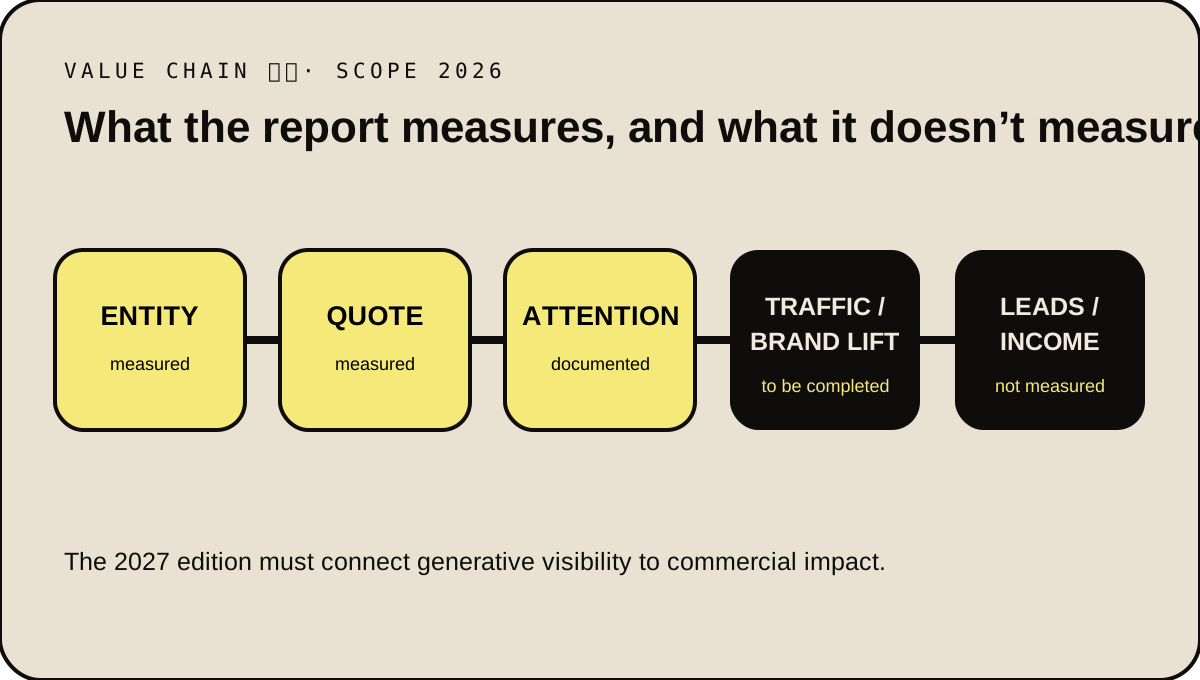
This report documents the first half of a value chain in detail. Structure, Flow, Trust build a recognized entity. This entity gets a citation. What this report does not yet measure, in this edition, is what happens after the citation.
ENTITY Structured, linked, proven. What the SFT method builds and what this report measures in Chapter 8.
QUOTE The entity appears in a generated response. Measurable by tracking quota share, chapter 14.
ATTENTION Brand recognition built through repeated exposure, including without clicking, chapter 11.
TRAFFIC / BRAND LIFT Brand searches, direct traffic, unsolicited mentions. Partially measurable today.
LEADS / REVENUE Commercial pipeline and attributable turnover. Not measured in this edition.
The first three links are documented in this report, with explicit sources and methodology. The last two are not yet. This is not an oversight. This is an assumed scope limit, which becomes the second priority of the 2027 edition, on par with the SFT-citation correlation validation of chapter 16.
A scope limit that must be named, not hidden
The SFT method documents how a machine recognizes, relates, and verifies an entity. It does not document how a human comes to desire a brand before even formulating a search. These two layers are distinct and complementary. Brand desirability, content distribution, community, editorial authority built by third-party creators, remain levers of generative visibility that this report does not address in depth.
Note from John Mingam. > A generative system can cite a perfectly structured entity that no one is actively looking for. It more often cites an entity that the public conversation already mentions, on Reddit, in the media, in specialized communities, chapter 11. Entity engineering increases the probability of being cited once the conversation
exists. She doesn't create the conversation herself.
What changes for a commercial offer
An isolated SFT audit answers the question “is this organization structured to be recognized”. It doesn't answer the question "does this organization generate enough third-party conversation to be cited often." A comprehensive offering combines both: the entity engineering documented in this report, and public relations, community presence and third-party content production work that goes beyond the strict scope of the SFT method.
Measuring full business impact:brand share of voice, brand searches, attributable leads, revenue generated:requires instrumentation that goes beyond citation tracking alone. This is the question that the 2027 edition will have to begin to answer, beyond just the statistical validation of the SFT score.
Appendix C. Industrialization
An intellectually interesting method is not automatically a method deliverable by a team of ten consultants without depending on its creator. This is the question that a performance director legitimately asks before any commercial engagement. This annex responds directly, without inflating what has not yet been constructed.
Honest answer question today. > Automable or manual scoring Complete automation of the three pillars since August 10, 2026, via Entity Confidence, the proprietary algorithm of the MI Intelligence Search SaaS. This tool was not used to produce the benchmark in Chapter 8, carried out using a manual single-evaluator method, Chapter 8 and Appendix B.
Delivery time Delivery time within 72 hours for a Mini SFT Audit, according to the existing productized offer.
Interrater reliability Not tested to date. Only one auditor produced the chapter 8 benchmark. This is a named limit, not a workaround.
Data retrieved automatically Wikidata queries, schema markup validation, cross-platform NAP consistency. Editorial quality and thematic relevance remain human judgments.
Monthly deliverable KPIs SFT score and cross-platform citation share, chapter 14. No leads or revenue KPIs yet, chapter 17.
Proof of incrementality Not established. This is the direct subject of the 2027 longitudinal study, chapter 16.
What this means for a team of ten consultants
Since August 10, 2026, the three pillars Structure, Flow and Trust have been evaluated automatically by Entity Confidence, the proprietary algorithm that powers the MI Intelligence Search SaaS. This automation is subsequent to the completion of the benchmark in Chapter 8, which remains a manual audit with a single evaluator, to preserve the consistency of the methodology described in Appendix B.
Comparing the scores produced by automation to those of a manual audit constitutes a validation test in its own right, distinct from the inter-rater test already identified, and adds to the priorities of the 2027 edition.
Note from John Mingam. > The answer to “how SFT works at 80 clients” has changed since August 10, 2026:
automation of the three pillars now exists via MI Intelligence Search. It was not used to produce this report, the benchmark of which in chapter 8 remains a manual audit. Its reliability in relation to qualified human judgment itself remains to be validated, not presumed.
Current pricing, without agency margin extrapolation
The existing productized offer includes three levels: a Mini SFT Audit delivered in 72 hours, SFT Support with personalized strategy and monthly monitoring, and a CMS SFT architecture for editorial redesigns. The reference daily rate is 950 CAD. This report does not model a hypothetical agency margin on the scale of 80 clients: this modeling belongs to commercial negotiation, not to a methodological publication.
Conclusion
Rank ranked URLs.
Citation evaluates identities.
SEO is not dead. Its nature has changed. Companies that are still optimizing only for keywords in 2026 are optimizing for a version of the game that no longer exists.
The SFT method is not presented as a demonstrated law. It is an operational framework built from verifiable data, published between 2025 and 2026, the empirical validation of which constitutes the next step. The Quebec market is used to it. It doesn't have the infrastructure yet.
This is where it comes into play.
John Mingam · Entity SEO & GEO · Montreal johnmingam.com · Wikidata Q127330925