Most agencies sell classic SEO on one side and GEO on the other, as two separate billing lines. This is not a packaging detail. It is the symptom of a methodology that never fully understood why both work through the same levers.
The SFT™ method does not need a separate GEO version, because Structure, Flow and Trust apply equally to Google, ChatGPT, Perplexity and other answer engines. The surfaces change. The trust mechanics remain the same.
What the GEO market really reveals in 2026
The GEO market is young, so it is segmenting fast. Rankings of Generative Engine Optimization agencies now appear everywhere, usually as comparative lists. LSEO publishes a 2026 GEO agency ranking. Digital Elevator does the same with an agency angle. Other players describe GEO as a new layer, sometimes as a standalone service, sometimes as an extension of SEO.
The fact that this question exists already says something. If GEO is sold as an extra checkbox, it means the original method did not fully include citation, entity and trust signals. Good technical SEO can get a site indexed. Good Entity SEO makes an entity understandable, verifiable and citable. That is the difference.
In plain terms: selling GEO as an add-on can reveal a methodological weakness. Not always. Some teams add an AI measurement layer because their historic tools did not cover it. But when the actual work changes name without changing levers, you need to ask what was missing from the initial SEO audit.
What Google confirmed
Google Search Central published official documentation on optimizing websites for Google Search generative AI features, including AI Overviews and AI Mode. The key point is simple: from Google's perspective, optimizing for generative AI search means optimizing the search experience. So it is still SEO.
This matters because it cuts through part of the marketing noise. Google does not say the new surfaces should be ignored. Google says the foundations remain the same: useful content, crawl accessibility, technical structure, quality, page understanding and coherent signals.
The same applies to files like llms.txt: they can help an agent understand a site quickly, but Google does not present them as a requirement for appearing in AI Overviews or AI Mode. The practical consequence is clear: you can document your entity for AI systems, but you cannot replace a solid SEO architecture with a magic file.
What academic research demonstrated
The strongest framework remains the GEO: Generative Engine Optimization study, associated with Princeton and IIT Delhi, and published in the KDD 2024 proceedings. The study tests several tactics across a large set of queries and shows that some interventions increase visibility in generative answers.
The winning tactics are revealing: citing sources, adding attributed statistics and including relevant quotations. In other words, gains come from proof and readability, not keyword stuffing. Keyword stuffing remains counterproductive. That verdict looks very close to classic SEO since Panda and Helpful Content: if content manipulates more than it informs, it loses.
This is not a coincidence. Classic search engines and generative engines converge toward the same requirement: choosing reliable sources. One ranks links. The other composes an answer. But both must solve the same question: which source deserves to be used?
Why SFT never needed a GEO version
SFT™ stands for Structure, Flow, Trust. The method was not designed as a Google checklist. It was designed as an entity framework.
Structure measures technical and semantic readability. A page must be crawlable, clear, organized and connected to coherent structured data. Whether the reader is Googlebot, GPTBot, PerplexityBot or a human, the information must be accessible and extractable.
Flow measures the circulation of meaning and authority. In classic SEO, Flow moves through internal linking, backlinks, pillar pages and relationships between pieces of content. In GEO, Flow also includes the ability of a source to be reused, cited, compared and connected to other sources in a generated answer.
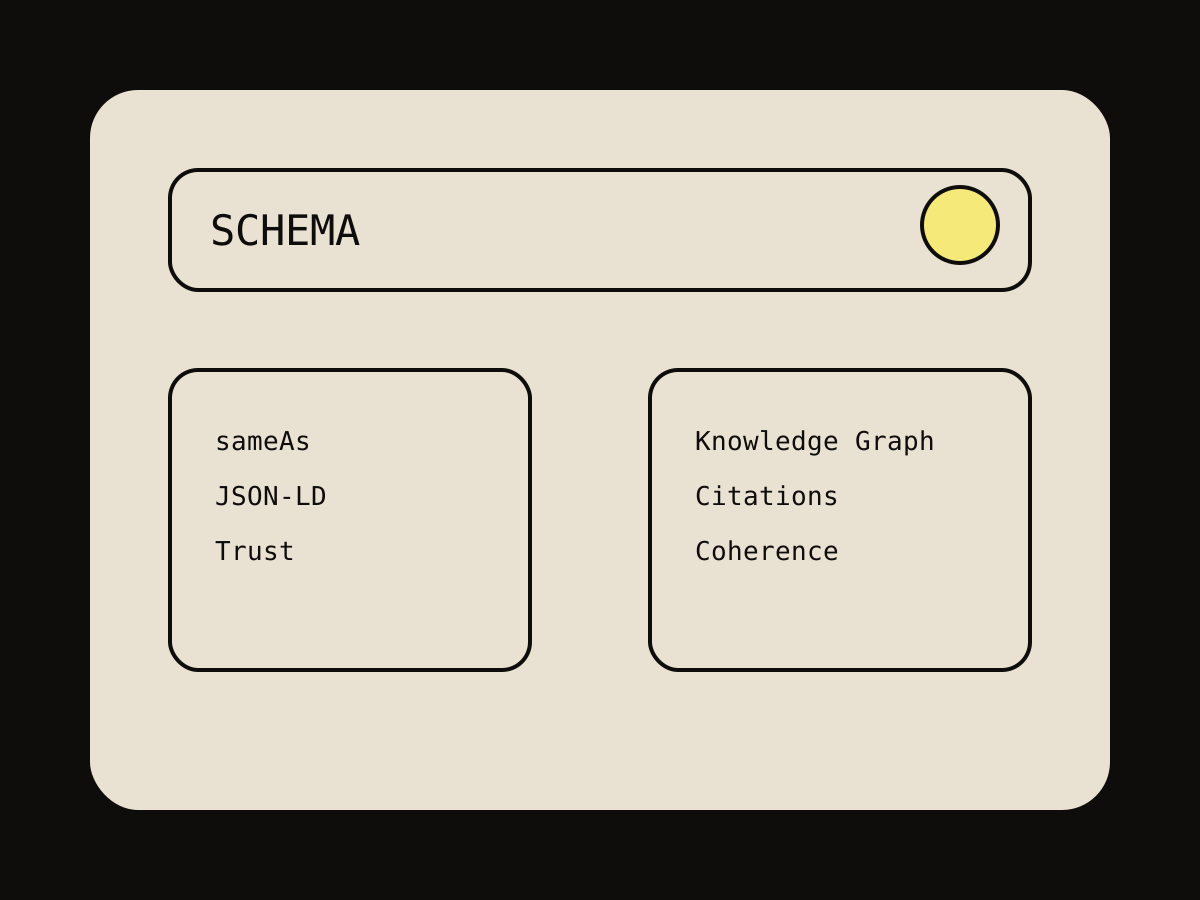
Trust measures proof. Identifiable author, cited sources, clean sameAs, Wikidata, coherence between the site and external profiles, third-party mentions, dates and stated limitations. This is the pillar that explains why an AI system chooses one source over another when two pages say almost the same thing.
These three pillars do not change when moving from Google to ChatGPT. Their weighting changes. That is very different.
The real problem with separate GEO offers
A separate GEO service can be useful when it adds specific measurement: AI share of voice tracking, prompt testing, ChatGPT or Perplexity citation analysis, comparison of retained sources. That is a monitoring layer.
But if the GEO service simply redoes what the SEO audit should already have covered, the problem is elsewhere. If the SEO audit did not analyze entities, structured data, sources, sameAs profiles, authorship, pillar pages and answer extractability, then it was not a complete audit for 2026.
GEO as an option then becomes an elegant way to sell the same correction twice. First under the name SEO. Then under the name GEO. The SFT method avoids this because it does not split the problem by channel. It splits it by function: make it readable, make it connected, make it believable.
What this changes in an audit
A serious SEO/GEO audit does not start by asking: Google or AI? It starts by asking: which entity must be understood, for which queries, on which surfaces, with which proof?
Only then do you look at the gaps. A slow page, a badly indexed page or a URL blocked by robots.txt is a Structure problem. Content without internal links, isolated from the rest of the site, is a Flow problem. An article without sources, clear authorship, external validation and coherent structured data is a Trust problem.
This produces cleaner recommendations. Fixing Organization schema improves Google understanding, but also entity recognition by AI systems. Rewriting a block as a direct answer improves extraction, but also citation. Adding real external sources improves editorial credibility, but also the likelihood of being reused by a generative engine.
Where SEO and GEO actually diverge
Precision matters: SEO and GEO are not identical in their metrics. SEO measures rankings, traffic, impressions, clicks and conversions. GEO measures citations, mentions, AI share of voice, presence in answers and the quality of cited sources.
The surfaces do not all work the same way. AI Overviews strongly depend on the Google Search ecosystem. Perplexity cites sources more visibly. ChatGPT can answer with or without browsing depending on the context, model, product and settings. Gemini sits inside a broader Google environment.
But this measurement divergence does not justify two separate disciplines. It justifies one method with different dashboards.
What a decision-maker should ask before buying
Before buying a GEO offer, ask three simple questions.
- Does your SEO audit already cover entities, Schema.org, sameAs, sources and AI citability?
- Does your GEO offer add a new measurement layer, or does it only rename classic SEO corrections?
- Can you connect every recommendation to Structure, Flow or Trust without inventing an opaque score?
If the answer is vague, the issue is not GEO. The issue is the method.
FAQ
Are SEO and GEO really the same discipline?
For Google Search, optimizing for generative AI features remains SEO. For ChatGPT or Perplexity, the metrics change, but the core levers remain the same: technical structure, authority flow and verifiable trust signals.
Why do some agencies sell GEO as a separate service?
Often because their historic SEO offers did not already include entities, sources, schema, AI citation and share of voice measurement. A separate service can be useful for measurement, but not for rebuilding the foundations.
What does the SFT™ method add?
SFT evaluates an entity through three pillars: Structure, Flow and Trust. These pillars apply to classic SEO and GEO, avoiding the artificial separation between Google and AI systems.
Do classic SEO tactics work for AI citation?
The foundations do: crawl, performance, useful content, authority and structure. But the format must become more extractable: direct answers, cited sources, structured data and self-contained paragraphs.
Should GEO still be measured separately?
Yes. Citations, brand mentions and retained sources need dedicated tracking. But separate measurement does not mean building two contradictory methods.