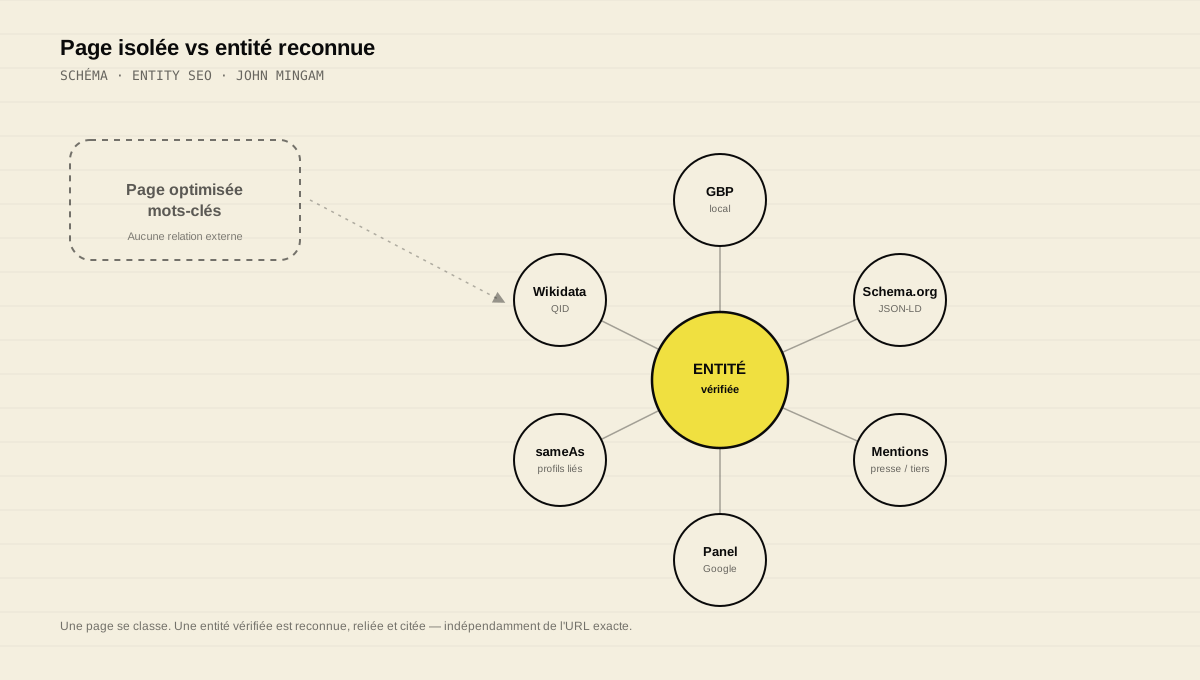
In 30 days, you can make a person or organization much easier to identify through a stable name, a reference page, consistent structured data, connected profiles and external evidence. This work does not guarantee a knowledge panel or a display deadline. It builds the signals Google can use to resolve the entity with less ambiguity.
What the Knowledge Graph actually is
Google uses the Knowledge Graph to connect real-world entities—people, organizations, places, works and products—to their attributes and relationships. It helps the search engine distinguish an entity from a word and understand that a person authored a book, works in a field and owns several official profiles.
A knowledge panel is one visible expression of that understanding. The panel and the graph are not the same thing. An entity may be understood without receiving a panel, and the panel shown may vary by query, country and device.
A rich result enhances a specific page through supported structured data. The Knowledge Graph consolidates information about an entity from multiple sources. Adding a Person or Organization block cannot trigger a panel by itself.
Key point: JSON-LD declares an identity. Independent sources corroborate it. Google then decides how to use the information.
The five foundations of an identifiable entity
1. Define a canonical identity
Choose a stable name, entity type, reference URL and factual description. Then create one internal identifier, such as https://example.com/#person. Other pages should reference the same @id instead of introducing variants.
2. Structure the data with JSON-LD
The markup must match visible content:
{
  "@context": "https://schema.org",
  "@type": "Person",
  "@id": "https://example.com/#person",
  "name": "First Last",
  "url": "https://example.com/",
  "jobTitle": "SEO and GEO consultant",
  "sameAs": [
    "https://www.linkedin.com/in/example/",
    "https://www.wikidata.org/wiki/Q000000"
  ]
}
Reuse that identifier in author, founder, creator or publisher. Avoid declaring the same entity under several IDs, mixing Person and Organization, or connecting profiles that represent different entities.
3. Build a reference page
An About or Author page should answer five questions: who is this person or organization, what do they do, where do they operate, which achievements can be verified, and which external sources support those claims?
Add a precise biography, recognizable image, publications, appearances, affiliations and official links. Connect the page from the homepage and signed content so that its role in the site architecture is explicit.
4. Align official profiles
Compare the name, role, image, URL and description across LinkedIn, author profiles, publishing platforms and legitimate professional directories. Minor wording differences are normal. Conflicting roles, dates or official websites create ambiguity.
Use sameAs for official equivalent profiles. Interviews, media articles and event pages are evidence or mentions, not identity-equivalent profiles.
5. Earn independent corroboration
The hardest work happens outside the website. Publications, documented talks, podcasts, professional associations, cited studies and editorial coverage give search systems independent reasons to trust an assertion. Context matters as much as the link: a page that clearly connects a name, role, topic and achievement helps resolve the entity better than an unexplained directory entry.
A 30-day action plan
Days 1–5: audit and disambiguation
- Inventory name variants and possible namesakes.
- Select the canonical URL and
@id. - Review public biographies, images, roles and locations.
- List contradictions that need correction.
- Save a dated baseline.
Days 6–10: authority centre
- Complete the About or Author page.
- Add visible evidence and source links.
- Implement one
PersonorOrganizationJSON-LD entity. - Connect articles, services, books and organizations to the correct ID.
- Test rendered HTML and structured data.
Days 11–18: external consistency
- Correct the most visible official profiles first.
- Use the same official website and compatible descriptions.
- Connect profiles where platforms allow it.
- Update Wikidata only with sourced claims that follow its rules.
- Do not create a promotional Wikipedia page; independent secondary sources and notability requirements still apply.
Days 19–25: evidence
Publish or expose assets others can cite: original research, a documented method, a book, a dataset, a talk or a sourced analysis. Distribute the asset where it provides relevant information. The value of the resource should motivate coverage, rather than an artificial request for a link.
Days 26–30: validation and monitoring
Recrawl the pages, validate the IDs, check canonicals and review external profiles. Observe branded queries across relevant countries and devices. Record dates and screenshots, then repeat the review monthly because entity recognition changes over time.
Observed case: John Mingam
Work around John Mingam combined a structured personal website, publications, author profiles, consistent identity signals and a Wikidata record corrected from available sources. A panel associated with his name was observed about three weeks after the last set of updates.
The timing does not prove that one specific change caused the display. It shows that a coherent group of signals was available at that point. The same delay should never be presented as a universal promise.
Mistakes that prevent consolidation
Using several identifiers. Choose one internal ID and connect external identifiers with sameAs.
Treating markup as sufficient. A self-declared graph still needs independent corroboration.
Forcing Wikidata or Wikipedia. Both platforms have their own sourcing and notability rules.
Creating artificial profiles. A relevant editorial source is more useful than ten weak directories.
Promising a panel in 30 days. The plan completes the foundations in a month. Google controls the decision, timing and presentation.
How to measure progress
Track observable facts: contradictions resolved, essential properties covered, pages referencing the correct ID, aligned official profiles, verifiable external mentions and changes in branded results. Keep dated snapshots and separate correlation from causality.
Continue with the Entity SEO guide, reference sources for entities, the SFT method and the canonical Entity SEO concept.
FAQ
Can a Knowledge Panel be guaranteed within 30 days?
No. The foundations and inconsistencies can be addressed in 30 days, but Google decides whether, when and how a panel appears.
Is a Wikipedia page mandatory?
No. Wikipedia can be an important source when an entity satisfies its notability rules, but it is neither mandatory nor a promotional tool.
Is a Wikidata item sufficient?
No. Wikidata can provide an identifier and sourced properties. It does not replace a clear official website, consistent profiles and independent corroboration.
How does Schema.org differ from the Knowledge Graph?
Schema.org provides a vocabulary for explicitly describing information on a page. The Knowledge Graph connects and consolidates information from multiple sources.