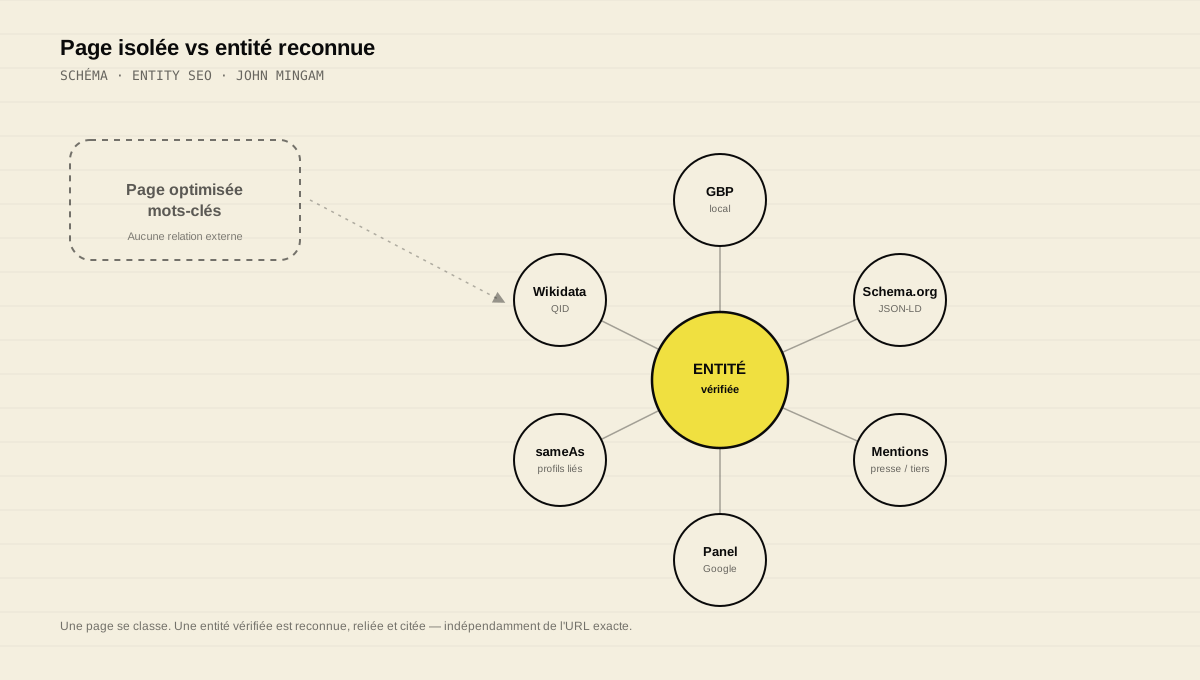
Google does not provide a form for directly creating a Knowledge Graph entry. The practical work is to make a person or organization identifiable, connect official presences and support important properties with independent sources. Google then decides whether to use the information and display a Knowledge Panel.
What the Knowledge Graph actually is
Google builds representations of people, organizations, places, works and concepts, then connects those entities to properties and relationships. This system is its Knowledge Graph.
In 2020, Google said the graph contained more than 500 billion facts about five billion entities. That figure is a historical order of magnitude, rather than a live count published every year.
A box displaying a name, image, description and profiles in branded search results is a Knowledge Panel. The panel is a visible interface. The Knowledge Graph is the underlying system that may supply it. An entity can be understood without receiving a panel for every query.
Entity SEO therefore aims to reduce ambiguity and provide verifiable information. It cannot force Google to display a panel.
Why an optimized page is not enough
A page may rank while Google remains uncertain about its author or publisher. Entity resolution depends on three questions:
- Who is it? A canonical name, type and reference URL.
- Which properties are verifiable? Role, location, works and relationships.
- Which independent sources support them? Publications, institutional profiles, media or structured databases.
The official website makes a first-party declaration. External sources provide corroboration.
Five signals to consolidate
1. Canonical identity
Define a stable public name, entity type and official URL. Create one permanent internal @id, such as https://example.com/#person, and reuse it across articles, services and works.
Natural wording differences are acceptable. Conflicting roles, official websites or dates create more serious ambiguity.
2. Connected official presences
Select profiles that genuinely represent the same entity: the official website, LinkedIn, author profiles, professional organizations and relevant databases. Check names, descriptions, URLs, locations and important relationships.
Value comes from mutual confirmation, rather than profile count.
3. Consistent structured data
Schema.org makes the declaration explicit in rendered HTML:
{
  "@context": "https://schema.org",
  "@type": "Person",
  "@id": "https://example.com/#person",
  "name": "First Last",
  "url": "https://example.com/",
  "jobTitle": "SEO and GEO expert",
  "sameAs": [
    "https://www.linkedin.com/in/example/",
    "https://www.wikidata.org/wiki/Q000000"
  ]
}
Use sameAs for identity-equivalent official profiles. An interview or news story is evidence or a mention, rather than necessarily the same entity page. Markup should match visible content.
4. Verifiable external authority
Interviews, books, documented talks, cited studies and institutional profiles give search systems independent evidence. Context matters: a source connecting a name, role, topic and specific work is more useful than an unexplained directory link.
5. Relevant external identifiers
Wikidata can provide a stable identifier and sourced properties. It is neither mandatory for Google recognition nor sufficient for a Knowledge Panel. Entries must follow Wikidata’s sourcing and notability policies. Wikipedia has separate rules based on significant independent secondary coverage and should not be treated as a promotional SEO tool.
Applying SFT to entity construction
Structure examines one stable ID, the appropriate Schema.org type, a canonical page, compatible properties and durable URLs.
Flow examines how evidence is connected: the Author page linked from the homepage, articles assigned to the same ID, official profiles pointing to the site, and contextual links to works or organizations.
Trust examines independent editorial sources, verifiable publications, dated references and material contradictions.
SFT is a proprietary audit framework. Its scores are not Google metrics and cannot predict whether a panel will appear.
A seven-step implementation plan
Step 1: audit the identity
Inventory URLs, profiles, biographies, images and key properties. Record contradictions and namesakes, then save a dated baseline.
Step 2: choose the canonical centre
Build a complete About, Author or Organization page with a clear description, verifiable work, important relationships and official profiles.
Step 3: create the Schema.org graph
Declare one Person or Organization, then reference its ID from articles, books, services and related pages. Test the HTML delivered to crawlers.
Step 4: align priority profiles
Correct material information on legitimate profiles. Add the official site and reciprocal links where appropriate. Avoid distributing copied biographies across low-quality directories.
Step 5: document external evidence
Publish original work and make its evidence accessible. Pursue relevant interviews, contributions and editorial citations. This stage often takes longer than the technical changes.
Step 6: confirm indexability
Review HTTP status, canonicals, robots directives, internal links and structured data. Search Console can request crawling, but inspection and submission do not guarantee indexing.
Step 7: monitor without overclaiming
Track branded queries with a stable protocol and record country, device, date and wording. Treat a change observed after an implementation as correlation unless its cause is demonstrated.
What this process cannot do
It cannot order a Knowledge Panel, promise a 30-to-90-day timeline or guarantee traffic. It primarily helps systems attribute content, works and properties to a coherent identity. Any changes in click-through rate, credibility or content attribution should be measured separately.
Conclusion
Creating a Knowledge Graph “entry” means building a verifiable identity: one canonical definition, a coherent graph, connected official profiles and evidence outside the website. Code clarifies the first-party declaration. Independent authority gives other sources a reason to confirm it.
Continue with the 30-day Knowledge Graph plan, the Entity SEO guide, entity reference sources and the SFT method.
Frequently asked questions
What is Google’s Knowledge Graph?
It is a system that connects real-world entities to properties and relationships so Google can understand people, organizations, works and topics.
How do you create a Knowledge Graph entity for a person?
Define a canonical identity, build a reference page, implement consistent Person markup, connect official profiles and earn external sources that corroborate key properties. Google controls integration and display.
Is Wikidata mandatory for a Knowledge Panel?
No. A compliant, sourced Wikidata item may help identification, but it is neither mandatory nor a display guarantee.
How long does it take?
Technical corrections may take days. External corroboration and changes in Google’s systems have no guaranteed deadline.
What does `sameAs` do?
It connects the website entity to equivalent official profiles. It helps disambiguation but does not replace external evidence.