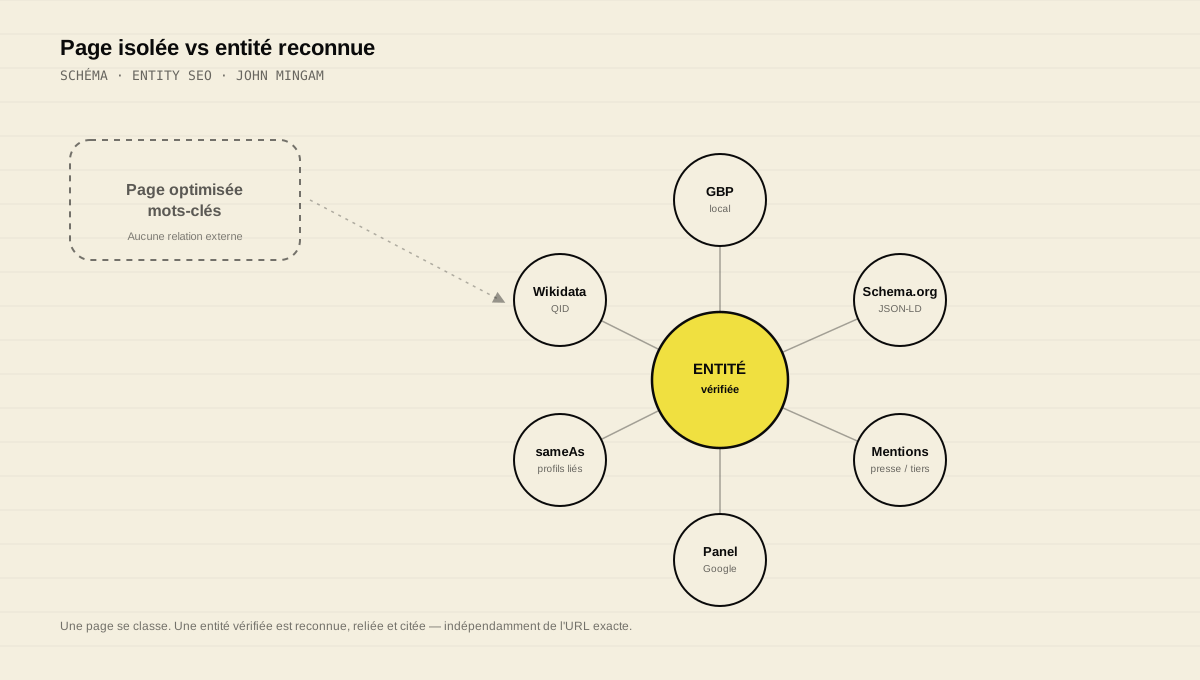
You search for a competitor and Google displays a panel with its logo, description and profiles. Your own branded query only returns ordinary links. This does not prove that Google “trusts” the competitor more. It often means its systems can resolve the entity more easily, find more stable properties or corroborate them through clearer sources.
What you are actually observing
The box beside search results is a Knowledge Panel. The Knowledge Graph is the broader system connecting people, organizations, places, products, works and concepts to properties.
No panel does not mean Google completely ignores your company. A site can be indexed, ranked and associated with a brand without triggering this interface. A panel also reveals no internal trust score and does not guarantee stronger non-branded rankings.
The difference is still useful evidence: Google has enough consolidated information to present the competitor as an entity for that query, country and date.
What Google may connect for the competitor
The outcome rarely comes from one tag. It usually reflects compatible signals:
- a stable canonical name and official URL;
- a clear Organization or About page;
- consistent structured data;
- connected official profiles;
- independent publications and mentions;
- important properties confirmed by several sources;
- a sufficiently distinctive branded presence.
Domain history, links and editorial coverage may contribute indirectly. A proper diagnosis compares evidence rather than attributing the result to semantic structure alone.
Four signal families to audit
1. Canonical identity
Review the public name, entity type, official website, logo, operating area and visible leadership. Typographic variations rarely destroy an entity. Conflicting official domains, addresses, dates or mixed person-and-company identities create more material ambiguity.
2. Schema.org and a stable identifier
An Organization node can declare the business explicitly:
{
  "@context": "https://schema.org",
  "@type": "Organization",
  "@id": "https://example.com/#organization",
  "name": "Example Company",
  "url": "https://example.com/",
  "logo": "https://example.com/logo.png",
  "sameAs": [
    "https://www.linkedin.com/company/example/"
  ]
}
Reference the same ID through publisher, provider, brand or worksFor where those relationships match visible content. JSON-LD clarifies a first-party declaration; it cannot validate an entity on its own.
3. Official profiles and identifiers
Use sameAs for official pages representing the same entity. LinkedIn, relevant industry databases and Wikidata may help when their data is accurate and policy-compliant.
Wikidata is neither mandatory nor an automatic Knowledge Panel route. Google Business Profile is primarily relevant to eligible local experiences and does not replace editorial corroboration.
4. Independent evidence
Media coverage, associations, events, studies, books, podcasts and specialized publications give Google independent reasons to connect a name to a field and specific work. A contextual source identifying the organization, people and contribution is clearer evidence than ten unexplained directory links.
Compare your brand with the competitor
Use an evidence table:
| Signal | Your brand | Competitor | Source | Priority |
|---|---|---|---|---|
| Canonical Organization page | Review | Review | Rendered site | High |
Stable @id | Review | Review | JSON-LD | High |
| Consistent official profiles | Review | Review | External sources | High |
| Independent publications | Review | Review | Documented research | High |
| Knowledge Panel observed | Yes / No | Yes / No | Date, country, device | Information |
Record URLs, screenshots and dates. Separate observations, hypotheses and recommendations.
What to correct this week
Day 1: select the primary entity
Decide whether a page represents a person, company or brand. Give each object its own canonical ID.
Day 2: consolidate the reference page
An About or Organization page should state the name, role, services, leadership, logo and important evidence. Link it clearly from the homepage.
Day 3: correct JSON-LD
Use the right Schema.org type, reference the same ID on relevant pages and remove contradictory declarations. Test the HTML delivered to crawlers.
Day 4: align official profiles
Correct official website, role, location, description and relationships. Add reciprocal links where useful and allowed.
Day 5: map missing evidence
Compare the competitor’s independent sources with yours. Identify what it actually created or documented: research, a book, event, partnership, interview or original data. Turn the gap into an evidence roadmap, rather than a backlink list.
Do not copy the competitor’s graph
Its entity reflects its own history, relationships and sources. Copying Schema.org types or directory placements cannot reproduce that evidence. Your durable advantage comes from original data, documented expertise, measurable cases and contributions others have a reason to cite.
Technical work reduces ambiguity. Distribution and external authority build the lasting difference.
Measure the gap
Track property consistency, JSON-LD relationships, confirmed official profiles, independent sources, observed branded results and accepted panel corrections when available. Describe a panel change as “observed after” an implementation unless causality is demonstrated.
Entity SEO can clarify identity, reduce contradictions and connect content to the right people and organizations. It guarantees neither a panel, rankings nor generative citations.
Continue with how to create a Knowledge Graph entity, the 30-day plan, the Entity SEO guide and the canonical Entity SEO concept.
Frequently asked questions
Why does my competitor have a Knowledge Panel when I do not?
Its identity may be easier to resolve and better corroborated through a canonical identity, official profiles, structured data and independent sources. A comparative audit is needed to find the exact gap.
Is Organization markup enough?
No. It clarifies the website’s declaration, while Google also compares information with other sources and controls display.
Should I create a Wikidata item?
Only when the entity meets the platform’s rules and its claims can be sourced. Wikidata may help identification but is neither mandatory nor a guarantee.
Does Entity SEO replace traditional SEO?
No. It complements technical, editorial and authority work by clarifying identities and relationships among people, brands, content and sources.